

Residence and work legalisation
We run the entire formal path of employing a foreign national: the work permit, the national D visa, the temporary residence permit and the residence card – then we keep track of every renewal deadline. You get a document set that is ready for a labour inspection or Border Guard check.
- Type A work permits and residence applications
- National D visas and consular handling
- Residence cards, renewals and term changes
- Documentation audit and deadline calendar
- Scope
- Work + residence
- Type A permit
- 30–90 days
- Residence card
- Filing and collection
- Deadline monitoring
- Yes, 60 days ahead
- Pricing
- Fixed fee per case
What residence and work legalisation covers
Legal employment of a non-EU national rests on two independent pillars: a residence title and a basis for performing work. Both must be valid at the same time and consistent with what actually happens on site. Our job is to reach that state and maintain it throughout the employment.
Residence title
A national D visa, visa-free travel or a temporary residence permit confirmed by a residence card.
Basis for work
A type A work permit, a declaration of entrustment of work or a single residence and work permit.
Factual consistency
The contract, position, working time and salary must match the content of the issued decision.
Who this service is for
Companies employing foreign nationals
You have non-EU workers on site and want certainty that every document is valid and every deadline is tracked in advance.
HR and payroll teams
We take the correspondence with the voivodeship office, consulates and sworn translators off your team's desk.
Employers hiring from Asia
We run the full path: work permit, national D visa, arrival and residence card after landing.
Companies after an inspection
We clean up the documentation, fix the gaps and put in place a procedure that prevents a repeat.
What exactly we do
We take over the whole administrative side – from analysing the candidate's status to an archive of documents ready for inspection.
Status and route analysis
We check citizenship, current residence title, entry history and the planned role, then choose the fastest lawful route.
Work permits
Preparing and filing the type A permit application (and types B–E where required), handling correspondence and collecting the decision.
Visa documentation
The full consular file, appointment booking and support for the candidate when applying for the national D visa.
Residence cards
Temporary residence and work permit application, employer annex no. 1, responses to office requests and card collection.
Renewals and changes
Deadline monitoring, permit renewals, new applications when a role or salary changes, and end-of-employment notifications.
Compliance and archive
An organised document set for every worker, ready to show to the labour inspectorate and Border Guard on the day of a check.
Types of legalisation documents
The right document depends on the candidate's citizenship, where they are when the process starts and the planned length of employment. Below are the variants we handle most often for employers in Poland.
Type A work permit
The core document for a non-EU national working under a contract with an entity based in Poland. Issued by the voivode for a specific employer, position, working time and salary – usually for up to 3 years.
Declaration of entrustment of work
A simplified route for citizens of selected countries, registered with the district labour office. It allows work for a limited period and works well as a bridge to a full type A permit.
National D visa
The residence title allowing entry and stay beyond 90 days. The candidate applies at the consulate with the work permit, preliminary contract, insurance and proof of accommodation.
Temporary residence and work permit
The single permit combining the right to stay and the right to work. The foreign national applies in person and the employer attaches annex no. 1 with the terms of employment. The result is a residence card.
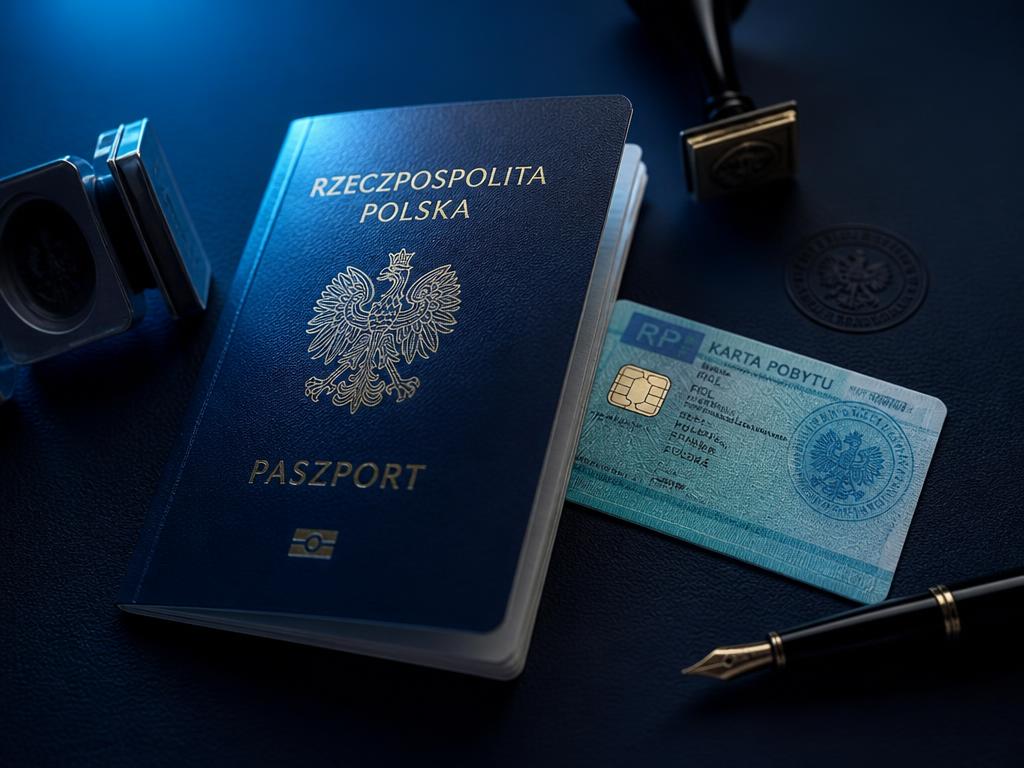
Residence card
The physical document confirming the residence permit. Together with a passport it allows border crossings without a visa and is the main document shown during checks.
Notification of entrustment of work
The electronic route for Ukrainian citizens under temporary protection – filed within 7 days of the work starting. Simple, but bound by a deadline that invalidates the legality of employment when missed.
Documents in practice
A type A work permit and a residence card – two documents we handle in parallel for your workers.
Type A work permits
Residence cards
Work legalisation step by step
The type A work permit route is the most common when bringing workers from Asia. Proceedings are handled electronically, and since June 2025 new rules remove the labour market test and tighten requirements on the content of the application.
- 01
Role profile and company check
Day 1–5We verify registry data, clearance with social security and tax authorities, the job description, occupation code and salary consistency with market conditions.
- 02
Assembling the file
Week 1–2Power of attorney, company documents, the candidate's passport and qualifications, and sworn translations where required.
- 03
Filing with the voivode
Week 2–3The application is filed electronically with attachments and proof of payment. From then on we handle all correspondence with the office.
- 04
Requests and decision
Week 4–12We respond to requests for additional documents on time, track the case status and collect the decision.
- 05
Visa and entry
Week 12–20The full visa file, consular appointment, national D visa, arrival and the first formalities on the ground.
- 06
Residence and renewals
After arrivalRegistration of stay, PESEL number, the temporary residence and work permit application, and a renewal calendar with reminders.
Residence card process
Application, biometrics, the voivode's decision and card collection – the full residence path.
- Applicationvoivodeship office
- Biometricsfingerprints
- Decisionvoivode
- Residence cardcollection
Residence legalisation after arrival
The first weeks after entry decide whether the rest of the employment runs smoothly. This is the moment for address registration, the PESEL number, insurance and filing the residence card application on time.
Address registration and PESEL
Registration of temporary stay and the PESEL number – required for tax settlements, opening a bank account and medical appointments.
Passport stamp
Filing the residence application during a period of legal stay results in a voivode's stamp: the stay remains legal until the decision is issued.
Health insurance
Social security registration within 7 days of employment and confirmation of insurance cover – also required in the residence proceedings.
Change of employer
A change of company requires a new permit or an amended residence decision. We run such cases without breaking the continuity of legal work.
Family residence
Temporary residence applications for the worker's spouse and children when the employer relocates the whole family.
Permanent residence and EU status
For long-serving workers we prepare permanent residence applications or EU long-term resident status.
How we run a case
The working model is the same whether we handle one case or a hundred.
Analysis and mandate
We establish the candidate's status and sign a power of attorney to represent you before the office.
File and application
We assemble attachments and translations and file the application electronically.
Running the proceedings
We answer official requests, track the case status and report every change.
Decision and monitoring
We hand over the decision, enter deadlines into the calendar and manage renewals.
Document status
You always see where each document stands – from filing the application to collecting the residence card.
Application
submitted
Type A permit
pending
Visa / entry
pending
Residence card
pending
How long it takes and what it costs
Timing depends on the voivodeship office, how complete the file is and consular workload. Official fees are settled at their actual amounts and our fee is fixed per case.
30–90 days
Type A work permit – from filing to decision
PLN 100
Fee for a type A permit for work longer than 3 months
PLN 440
Fee for the temporary residence and work permit application
Sworn translations and the residence card issue fee (PLN 100) are added to the budget. We present the full calculation before the case starts.
What stays on the employer's side
Even with full legalisation support, some duties follow directly from the law and remain with the employing company. We explain how to meet them and remind you of the deadlines.
Contract matching the permit
A written contract signed before work starts, translated into a language the worker understands, with terms no worse than those in the permit.
Copy of the residence document
The duty to request and keep a copy of a valid document authorising stay throughout the employment period.
Social security and tax
Registration for insurance within 7 days and payroll settlements on the same terms as for a domestic employee.
Working time records
Accurate records of hours and payments – the first document an inspector asks for during a foreign employment check.
Health, safety and medicals
Medical examinations, induction training and workstation instructions provided in a language the worker understands.
Notifications to the office
Informing the office about the start or non-commencement of work and about the end of employment within statutory deadlines.
Common mistakes and how inspections run
Most problems do not come from bad intent but from a mismatch between the document and reality on site. Below are four situations that most often end with an inspection report.
Work inconsistent with the permit
A different position, lower salary or different working time than in the decision is the most common irregularity found during inspections. Any material change requires a new or amended permit.
A gap in legal stay
An application filed after a visa or card expires breaks the continuity of legal stay and forces the worker to leave Poland. The deadline calendar matters more here than the content of the application.
Formal gaps in the file
Outdated registry data, a missing sworn translation or an incorrect occupation code can add several weeks to the proceedings.
Labour and Border Guard checks
Inspectors review residence documents, contracts, working time records and consistency with the permit. We keep the full set ready to be produced in one file.
Foreign employment document audit
If you already employ workers from abroad, we start with a review. The audit usually takes 5–10 business days and ends with a report listing risks by severity plus a remediation schedule.
Validity of residence titles
Checking expiry dates of visas, cards and stamps and identifying people at risk of a gap in legality.
Contracts vs permits
Comparing position, working time and salary against the content of the voivode's decision.
Completeness of worker files
Document copies, translations, medicals, health and safety training and social security confirmations.
A procedure for the future
Implementing a deadline calendar, document templates and a contact point in case of an inspection.
Nationalities we handle most often
Every direction has its own documentary requirements in the country of origin. We handle legalisation both for candidates we recruit ourselves and for workers your company found on its own.

Philippines
DMW route, consular documents and full work legalisation in Poland.

India
Verification of diplomas and technical qualifications, type A permits.

Nepal
Assembling departure documents and national D visa files.

Bangladesh
Visa application handling and residence legalisation after arrival.

Sri Lanka
NVQ certificates, sworn translations and work permits.

Indonesia
Departure registration, D visa and residence card in one schedule.
We also handle cases for citizens of Ukraine, Georgia, Uzbekistan, Belarus and Moldova – including simplified notification routes as well as standard work and residence permits.
What we guarantee
Deadlines under control
A validity calendar for every worker's documents with automatic reminders 60 days before expiry.
One case owner
The same person handles your cases from status analysis to residence card collection – no handovers between departments.
Documentation ready for inspection
Organised worker files with translations and confirmations that can be shown to an inspector immediately.
Clear pricing
A fixed fee for handling the case plus official charges at their actual amounts – no extra billing for correspondence and office requests.
Photos from legalisation work
Documents, passport stamps and visits to voivodeship offices across Poland.
Frequently asked questions
What is the difference between work legalisation and residence legalisation?
They are two separate tracks that must overlap in time. Work legalisation is the document allowing a specific job with a specific employer – usually a type A work permit or a declaration of entrustment of work. Residence legalisation is the right to stay in Poland: a national D visa, visa-free travel or a temporary residence permit (residence card). A foreign national needs a valid residence title and a valid basis for work at the same time – missing either one means illegal employment.
Who files the work permit application – the employer or the worker?
The type A work permit application is filed by the employer with the voivode competent for the company's registered office. The candidate only provides personal documents: passport, diplomas and proof of experience. It works the other way round for the temporary residence and work permit (residence card) – there the foreign national applies in person and the employer completes annex no. 1 with the terms of employment. We run both tracks under a power of attorney.
How long does a type A work permit take?
Realistically 30–90 days depending on the voivodeship office and how complete the file is. The biggest delays come from formal gaps, outdated company data in public registers and incorrect job descriptions. That is why we verify the full set of documents before filing – the cheapest way to shorten the process.
How much does legalising a foreign worker cost?
The cost consists of official fees (type A work permit – PLN 100 for work longer than 3 months, temporary residence and work permit application – PLN 440 plus PLN 100 for issuing the residence card), sworn translations, and our fee for handling the case. We present the full itemised calculation before we start.
Is a labour market test still required?
Since June 2025 a new act on the conditions for entrusting work to foreign nationals has been in force. It removes the labour market test (the starost's opinion) and moves proceedings into an electronic system. In practice the path is shorter, but the requirements for the content of the application and the consistency of employment terms are stricter. During the analysis stage we confirm which regime applies to your case and your office.
What are the penalties for illegal employment of a foreign national?
Entrusting work without a valid permit or contrary to its terms is an offence punishable by a fine for the employer and for the person acting on its behalf. With repeated breaches the office may refuse further permits for up to several years, and the case is passed to the Border Guard and the National Labour Inspectorate. The documentation we maintain is prepared for exactly that kind of inspection.
Can the worker keep working while waiting for the residence card?
Yes, provided the temporary residence and work permit application was filed during a period of legal stay and has no formal gaps – the voivode then places a stamp in the passport and the stay remains legal until the decision is issued. Continuing to work also requires a valid basis for work (for example a type A permit) or a filed application for a single residence and work permit. We monitor those deadlines for you.
Do you handle renewals and changes to employment terms?
Yes. We handle permit renewals, new applications when a position or salary changes, employer changes and notifications to the office when employment ends. Clients on a retainer receive a deadline calendar with reminders 60 days in advance.
Do you handle cases for Ukrainian citizens?
Yes. Ukrainian citizens under temporary protection follow a simplified route: an electronic notification of entrustment of work submitted within 7 days of the work starting. We also handle standard permits and residence cards for people who do not use that route.
What if I already employ foreign nationals?
We start with an audit: validity of residence titles, consistency of contracts with permit terms, working time records, translations and health and safety training. You receive a report listing risks by severity and a remediation schedule. Only then do we take over ongoing case handling.
Let us review your documents.
We reply within 48 hours with an assessment, costs and a schedule – no commitments and no upfront fees.