
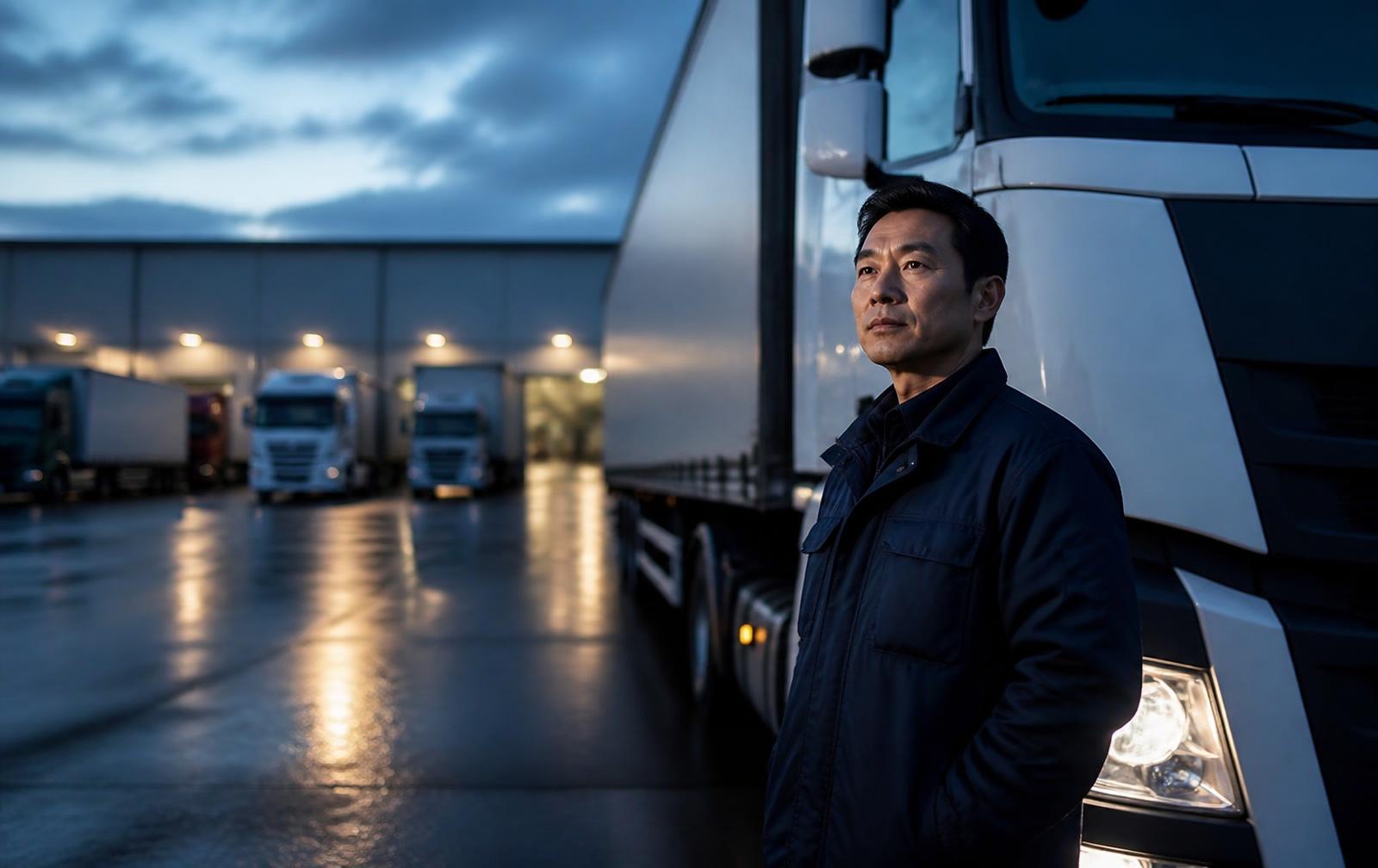
Drivers from Asia – C+E, C and B
We recruit international C+E drivers, distribution drivers, warehouse operatives and forklift operators for transport companies and logistics operators across Poland. We run the full path: selection and pre-selection, work legalisation, licence exchange with code 95, the driver card, arrival and onboarding on the first routes. Practical tests are available only as an optional paid add-on on client request.
- C+E, C and B drivers plus complete warehouse crews
- Licence exchange, code 95 and driver card handled by us
- Type A permits, visas, housing and transport to the depot
- Permanent recruitment, temporary work or process outsourcing
- Scale
- from 5 to 200+ people
- Start
- 4–7 months
- Qualifications
- C+E · code 95 · forklift
- Models
- Permanent · TWA · outsourcing
- Guarantee
- Driver replacement
Polish transport now recruits beyond Europe
Poland is the largest road carrier in the European Union and at the same time has not been able to fill its cabs from the domestic and eastern markets for years. Asian countries are no longer an emergency solution – for many fleets they are planned, repeatable intakes.
5–200+
drivers and warehouse staff in a single project
4–7 months
from contract to the first run with full qualifications
Code 95
initial qualification and licence exchange handled by us
6 countries
Philippines, India, Nepal, Uzbekistan, Sri Lanka, Indonesia
Challenges carriers bring to us
No drivers on the domestic market
The average driver age keeps rising and retirements are not being replaced. A parked truck still costs a lease instalment with no revenue.
A long qualification path
A non-EU driver needs a licence exchange and code 95. Without planning these in parallel with the visa, the project stretches by several months.
Turnover and poaching
An experienced driver changes company for a small pay difference. A group recruited abroad stays longer, because the contract is planned in years, not months.
Driving-time and tachograph compliance
Record-keeping errors mean penalties from the road transport inspectorate and lost good repute. Tachograph training happens before the first run, not after an inspection.
Who we recruit for transport and logistics
Most projects concern cabs, but we staff the back end in parallel: warehouse, cross-dock and sorting hubs. Roles requiring certification follow a separate, slower selection path.
International C+E drivers
International and long-haul transport, curtainsiders, reefers and containers, weekly route systems.
Category C distribution drivers
Domestic and regional deliveries, retail chain work, unloading at the customer, return to depot.
Category B van drivers and couriers
Deliveries, last mile, scanner and courier app operation, work in the sorting hub and on the route.
Forklift operators
Counterbalance, reach and high-rack trucks – with UDT certification or with certification obtained after arrival.
Warehouse operatives and pickers
Goods-in, order picking, scanners, WMS-based work, cold-store warehouses.
Sorting and cross-dock crews
Loading and unloading, parcel sorting, night shifts in courier hubs and cross-docks.
Driving licence, code 95 and driver card
This is the stage that most often stretches transport projects – which is why we run it in parallel with work legalisation, not after the driver lands. Below is the full path from a licence issued in Asia to a truck in your colours.
Licence verification in the home country
We check the category, issue date and professional history. Documents issued before 2008 usually follow a shorter exchange path than newer ones.
Translation and medical checks
Sworn translation of the licence, medical and psychological examinations for professional drivers, certificates for the personnel file.
Exchange for a Polish licence
Application at the traffic department, driver candidate profile, booking of the theory exam (and the practical one where the country requires it).
Initial qualification and code 95
We enrol drivers in accelerated initial qualification or periodic training and secure the code 95 entry, without which commercial transport is not allowed.
Driver card and tachograph
Driver card application plus training in digital tachograph operation, driving time, breaks and rest periods.
Additional training
ADR, truck-mounted cranes, load securing and reefer handling – arranged whenever your fleet and contracts require it.
Processing time depends on the country and the issue date of the document – licences issued before 2008 usually follow a path several weeks shorter.
Three ways to work with a carrier
The model depends on how much HR responsibility you want to keep in house. They can be combined – a core team of drivers employed directly, warehouse peaks covered by temporary work.
Permanent recruitment
The driver is employed directly by you. We handle selection, legalisation, qualifications, the flight and the first weeks of adaptation.
One-off recruitmentTemporary work
Employment on our side, flexible warehouse and sorting crews during seasonal peaks, billed per hour.
Temporary Work AgencyProcess outsourcing
We take over a defined part of your logistics – warehouse or cross-dock operations – with a coordinator and responsibility for the result.
OutsourcingSelection built around life on the road
A driver has to meet criteria you will not see in a CV: independence on the route, a week away from home, paperwork and dispatcher contact. We agree the filter before the project starts and apply it identically in every country.
Our recruitment filter
- Documented experience on vehicle combinations above 12 tonnes
- Valid C/C+E licence and a clean professional record
- Practical test on a manoeuvring yard and a driving recording
- Communicative English and willingness to learn basic Polish
- Medical and psychological examinations for professional drivers
- Acceptance of the work system: weekly routes, cab rest, weekends at the depot
What we confirm on your side
- Transport type: international, domestic, distribution, courier
- Trailer types and additional training required (ADR, crane, reefer)
- Work system, allowance settlement and depot return rules
- Accommodation standard and distance from the transport depot
- Who runs the mentored drives in the first weeks
- Scope of video interviews between your dispatcher and candidates
Legalisation and employment compliance
Documents are the longest part of the schedule, so we run them in parallel for the whole group rather than candidate by candidate. We work under a KRAZ certificate and contracts compliant with Polish labour law.
Type A work permit
We file the application for the specific driver or warehouse role, together with the labour market test where required.
National visa and entry
We compile visa documents, book appointments at consular posts and coordinate the flight and airport pickup.
Residence card and legal stay
After arrival we handle the temporary residence and work permit application, registration and notifications to the authorities.
Documentation for inspections
Driver file: qualifications, code 95, driver card, medical certificates, working-time records – ready for any inspection.
Details are described in our services residence and work legalisation and type A work permit.
First runs and first weeks at the depot
Whether a driver stays is decided in the first month. That is why onboarding is part of the project, not an add-on after arrival.
Week 1 – depot and documents
Airport pickup, accommodation, medical checks, health and safety training, driver card and company procedures.
Week 2 – driving with a mentor
First runs with an experienced driver or on domestic routes, learning the tachograph and the telematics system.
Weeks 3–4 – independent routes
Transition to independent jobs, contact with the dispatcher in the working language, ongoing correction of driving style and settlements.
Months 2–3 – stabilisation
Report for the carrier: punctuality, fuel consumption, damages, absences. A coordinator supports the driver with official and everyday matters.
How a project for a transport company runs
01 · Fleet and route analysis
We define the transport type, work system, required qualifications and a realistic timeline for drivers joining.
02 · Campaign and selection
Sourcing in the selected countries, document verification and video interviews with your team. Practical tests are available only as an optional paid add-on on client request.
03 · Work legalisation
Type A permits, visa applications and full documentation run in parallel for the entire group.
04 · Qualifications and code 95
Licence exchange, initial qualification, driver card and any additional training your fleet requires.
05 · Arrival and accommodation
Tickets, airport pickup, housing near the transport depot and transport to site.
06 · Onboarding and care
Mentored runs, a coordinator for the group, staffing reports and a driver replacement guarantee.
Where we source drivers and logistics staff
We match the country to the role, language requirements, budget and deadline. For larger fleets we run sourcing in two or three countries at the same time.

Philippines
Very good English and experience from Middle Eastern markets, including container transport.

India
The widest availability of truck drivers and fleet mechanics, large candidate volumes.

Nepal
Warehouse and sorting-hub staff focused on long contracts and shift work.

Bangladesh
Warehouse, cross-dock and picking crews for high-volume projects.

Sri Lanka
Distribution drivers and forklift operators, high discipline and low turnover.

Indonesia
Warehouse and cold-chain logistics, strong results on night shifts in hubs.
Risks we remove at the start
Transport projects fail for a handful of recurring reasons. We address each of them before the recruitment campaign even launches.
A driver on the road without code 95
Training slots are booked before arrival and the driver is cleared for commercial transport only once the entry is in the licence.
Penalties for driving time and tachograph errors
Training on records, breaks and rest periods is mandatory, and the first weeks are driven under a mentor's supervision.
Expiring documents and qualifications
A register of permit, residence card, medical and code 95 deadlines with lead time, so renewals start before anything expires.
Disappointment with conditions after arrival
Rates, the route system, accommodation standard and allowance rules are presented before departure – this is the main cause of early departures.
Photos from driver onboarding
Training, vehicle documentation and the first days of C+E drivers at Polish carriers.
Frequently asked questions about drivers from Asia
Are Asian C+E driving licences recognised in Poland?
A licence issued outside the EU has to be exchanged for a Polish one – usually with a theory exam and, for some countries, a practical one. We run the whole process: sworn translation, medical and psychological tests, the application at the traffic department and exam booking.
What about Driver CPC (code 95)?
To carry goods commercially in the EU a driver needs code 95 entered in the licence. We send candidates to accelerated initial qualification or periodic training at a Polish training centre and make sure the entry is in place before the first job.
How long does it take before the driver's first run?
Realistically 4–7 months. Selection takes 2–4 weeks, work legalisation and the visa 3–4 months, and the licence exchange with code 95 another 2–3 months – several of these stages run in parallel.
Do the drivers have experience with articulated trucks?
Yes. Documented experience on vehicles above 12 tonnes is the standard, and for international transport we verify it with references and route documentation. A practical test on a manoeuvring yard is available only as an optional paid add-on on client request.
Will the driver handle the tachograph and driving-time rules?
Digital tachograph operation, breaks and rest periods are a mandatory part of training before the first run. On top of that, the first weeks are driven with a mentor or on domestic routes.
What language do the drivers speak?
We require communicative English and, for larger groups, we provide a coordinator who speaks the workers' language. Instructions, loading procedures and CMR documents are prepared bilingually.
Do you recruit only C+E drivers?
No. We cover the whole logistics chain: warehouse operatives, forklift operators, order pickers, packers, category C and B drivers (delivery, courier) and sorting-hub staff.
Who arranges accommodation between runs?
We can take care of everything – compliant accommodation, transport to the depot and airport pickup – or bill only recruitment and legalisation if you already have the facilities.
What if a driver does not work out on the route?
A replacement guarantee applies for the period set in the contract. More often we move the person to domestic transport or distribution and send another candidate to the international routes.
How is the service billed?
Usually a fee per driver paid in instalments tied to project milestones (start, documents, arrival, licence exchange), or an outsourcing model with an hourly rate where employment and HR stay on our side.
Can we start with a smaller group?
Yes, and we usually recommend it. A first batch of 5–10 drivers lets you test onboarding, accommodation and communication with the dispatcher before scaling to full volume.
Is hiring drivers from Asia legally safe?
Yes, as long as the documents are complete and current. We operate under a KRAZ certificate, keep a document register for every driver and track renewal deadlines so legal employment and qualifications are never interrupted.
We will fill your cabs and your warehouse.
We reply within 48 hours with a recommended sourcing country, a qualification timeline and a full cost per driver – with no commitment.