
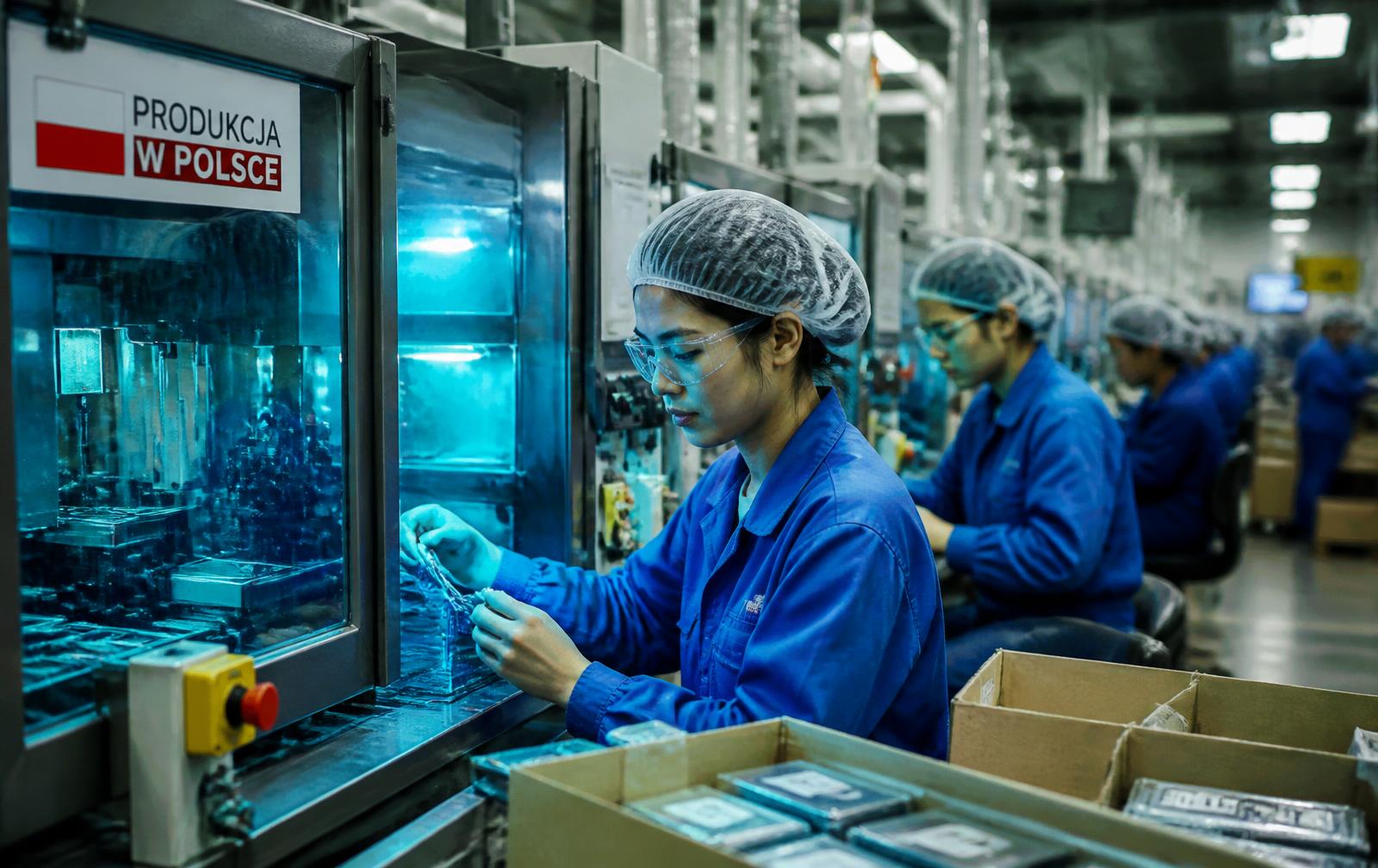
Production workers from Asia
We recruit machine operators, assemblers, packers and quality controllers for manufacturing plants across Poland. Candidates from Asia and third countries are screened for real experience on a line, we run the full legalisation, flight and accommodation, and we bring people in batches at a pace your plant can actually onboard.
- Operators, assembly, packing, quality control
- Readiness for a full three-shift system
- Permits, visas, housing and transport on our side
- Permanent hire, temporary work or process outsourcing
- Scale
- 5 to 500+ workers
- Start
- 8–14 weeks
- Shift system
- 1, 2 or 3 shifts
- Models
- Permanent · TEA · outsourcing
- Guarantee
- Worker replacement
Manufacturing is now an industry that recruits abroad
Polish plants have not been able to close their staffing from the local market for years – especially on second and third shifts and in repetitive work. Recruitment from Asia has stopped being an emergency measure and has become a planned part of a factory's workforce strategy.
50–500+
workers in a single production project
8–14 wks
from contract to the first batch on the floor
3 shifts
readiness for a full shift system
6 markets
Philippines, India, Nepal, Bangladesh, Sri Lanka, Indonesia
Challenges plants come to us with
Staff shortages on the line
The local market no longer supplies operators and packers at the required scale, and one vacancy can stop an entire shift.
Seasonal production peaks
A contract or a season needs dozens of people on one date. We plan the schedule backwards from the go-live day.
Turnover and unpredictable staffing
Constantly patching the roster costs more than a stable group planned for a contract of many months.
Hard-to-fill technical roles
Setters, electricians and maintenance mechanics require a separate selection track and qualification checks.
Who we recruit for factories
Most projects cover roles that can be described with a repeatable profile and onboarded in a short training. We also fill technical positions, for which we run a separate, slower selection track.
Machine and line operators
CNC machines, injection moulding, presses, filling and packing lines, basic parameter setting.
Assembly and components
Mechanical and electronic assembly, work to a workstation instruction, conveyor assembly.
Packing and co-packing
Manual and machine packing, labelling, palletising, preparing shipments.
Quality control
Visual inspection, measurements, filling in control cards, separating defects.
In-plant warehousing
Feeding the line with components, order picking, forklift operators with valid licences.
Maintenance
Mechanics, electricians, machine setters and technicians – recruited with detailed qualification checks.
Three models of working with a plant
The model depends on how much HR responsibility you want to keep in-house. They can be combined – a core team hired directly, with seasonal peaks covered by temporary work.
Permanent recruitment
The worker is employed directly by you. We handle selection, legalisation, the flight and the first weeks of adaptation.
Mass recruitmentTemporary work
Employment on our side, a flexible headcount per shift and billing for hours actually worked.
Temporary Employment AgencyProcess outsourcing
We take over a defined part of production or packing together with a foreman, roster and responsibility for the result.
Worker outsourcingSelection built for the shop floor
A production candidate must meet criteria a CV never shows: pace, standing work, noise, shift rotation. We fix the filter before the project starts and apply it identically in every country.
Our recruitment filter
- Documented production experience – line, machine, assembly or packing
- An optional practical test or video recording from a real workstation (paid add-on on client request)
- Interview with a recruiter in the candidate's language and an English check
- Declared readiness for shift work, including nights and weekends
- Health screening and fitness for physical, standing work
- Verification of ID documents, licences and previous work-abroad history
What we agree on your side
- Workstation card: tasks, pace, norms and physical load
- Shift system, overtime and weekend work
- Required English level and foreman availability
- Housing standard, transport and distance from the plant
- Batch sizes and the training capacity of your production team
- Scope of video interviews between your team and candidates
Legalisation and employment compliance
Documents are the longest part of the schedule, so we run them in parallel for the whole group rather than candidate by candidate. We work under a KRAZ certificate and contracts compliant with Polish labour law.
Type A work permit
Application, document collection and case handling at the voivodeship office – for the whole group in parallel.
Visas and arrival
Visa applications, consulate appointments, tickets and an arrival schedule matched to onboarding batches.
Residence cards and renewals
We track deadlines so the continuity of legal employment is never broken during the contract.
Inspection-ready documentation
A complete document set per worker, notifications to the authorities and a deadline register – ready for Labour Inspectorate checks.
Details are covered in residence and work legalisation and type A work permits.
The first weeks on the floor
Whether a group stays is decided in the first month. That is why onboarding is part of the project, not an add-on after landing.
Day 0 – arrival and housing
Airport pick-up, transport to accommodation, SIM cards, first shopping and a starter briefing in the worker's language.
Day 1–3 – safety and induction
Health-and-safety and workstation training with interpretation, bilingual instructions, workwear and ID badges.
Week 1–4 – adaptation on the line
Paired work with an experienced operator, contact with the coordinator and station reassignment after the first review.
Month 2+ – stabilisation
Regular coordinator visits, handling of housing and administrative matters, retention reporting and planning of further batches.
How a project for a manufacturing plant runs
01 · Plant analysis
We map the roles, shift system, physical and language requirements and your real housing and training capacity.
02 · Profile and schedule
We build the workstation card and the batch plan, counting deadlines backwards from the day people must be on the floor.
03 · Sourcing and selection
Parallel channels in two or three countries, one uniform filter, and candidate cards with video recommendations.
04 · Approval and legalisation
You approve the list; we launch permits and visas for the entire group at once.
05 · Arrival in batches
Tickets, airport pick-up, accommodation and shift transport according to the agreed schedule.
06 · Onboarding and care
Training, an on-site coordinator, weekly staffing reports and a replacement guarantee.
Where we source production workers
The country is matched to the role, language requirements, budget and deadline. For large volumes we source in two or three countries at once.

Philippines
Excellent English, experience in international plants, high retention.

India
Broad availability of operators and technicians, including heavy-industry backgrounds.

Nepal
Manual workers focused on long contracts and shift work.

Bangladesh
Experience in light industry, textiles and packing; strong for volume projects.

Sri Lanka
Precision assembly, quality control and repetitive work with high discipline.

Indonesia
Food production and processing, strong results in three-shift work.
Risks we eliminate up front
Production projects fail for a handful of recurring reasons. Each of them is addressed before the recruitment campaign even starts.
Downtime from an unstaffed shift
We plan surplus candidates in every batch and keep a reserve list so a single withdrawal never stops the line.
Language barrier at the machine
Bilingual instructions and safety training, a foreman or interpreter in the group, and pictograms at workstations.
Expired worker documents
A deadline register for permits and residence cards, so renewals start before a document expires.
Early departures
Conditions, pay and housing standards are presented to the candidate before departure – disappointment on arrival is the main driver of turnover.
Photos from production floors
Workers from Asia on the production shift in Polish plants.
Frequently asked questions about production workers
How many production workers can you supply?
From single machine operators up to teams of 50–500. On larger projects we deliver people in batches of 20–50 so the plant can realistically train and accommodate them.
How long does production recruitment take?
With candidates from Asia and other third countries it usually takes 8–14 weeks from signing to the first people on the shop floor. Selection closes in 2–4 weeks; the rest is legalisation – work permit and visa.
Do the workers have production experience?
Yes – documented experience on a line, at a machine or in packing is the standard. For technical roles we additionally verify qualifications and video from previous work. Optional practical tests are available only as a paid add-on on client request.
What language do the workers speak?
Basic English is the norm, and for larger groups we assign a foreman or interpreter who speaks the workers' language. Workstation and health-and-safety instructions are prepared bilingually.
Do you handle employment legalisation?
Yes. We run type A work permits, visa applications, residence cards, registration and notifications to the authorities. Documentation is ready for inspection by the Labour Inspectorate and Border Guard.
Who provides accommodation and shift transport?
We can take over everything: compliant worker housing, transport to the plant and airport pick-up. You can also keep these on your side – then we invoice recruitment and legalisation only.
Will the workers cope with shift work?
Readiness for a three-shift system and weekend work is checked during selection and written into the offer. Candidates from Asian markets typically come precisely for shift work with overtime.
What if a worker doesn't fit the role?
They are covered by a replacement guarantee for the period set in the contract. In practice most such cases are solved by moving the person to another station – after the first weeks it is clear who fits a machine and who fits packing.
How is it billed?
Most often a fee per worker paid in instalments tied to project milestones (start, documents, arrival), or an outsourcing model with an hourly rate where employment and HR stay on our side.
Can we test a smaller group first?
Yes, and we often recommend it. A first batch of 10–20 people lets you verify onboarding, housing and shop-floor communication before the full volume starts.
Do you also cover maintenance technicians?
Yes. Electricians, mechanics, machine setters and maintenance technicians follow a separate selection track with qualification checks, run as part of our specialist search.
Is hiring foreign workers in a factory legally safe?
Yes, provided documents are complete and current. We operate under a KRAZ certificate, keep a document register for every worker and track renewal deadlines so legal employment is never interrupted.
We will staff every shift in your plant.
We reply within 48 hours with a recommended sourcing market, a batch schedule and a full cost-per-worker calculation – with no obligation.