
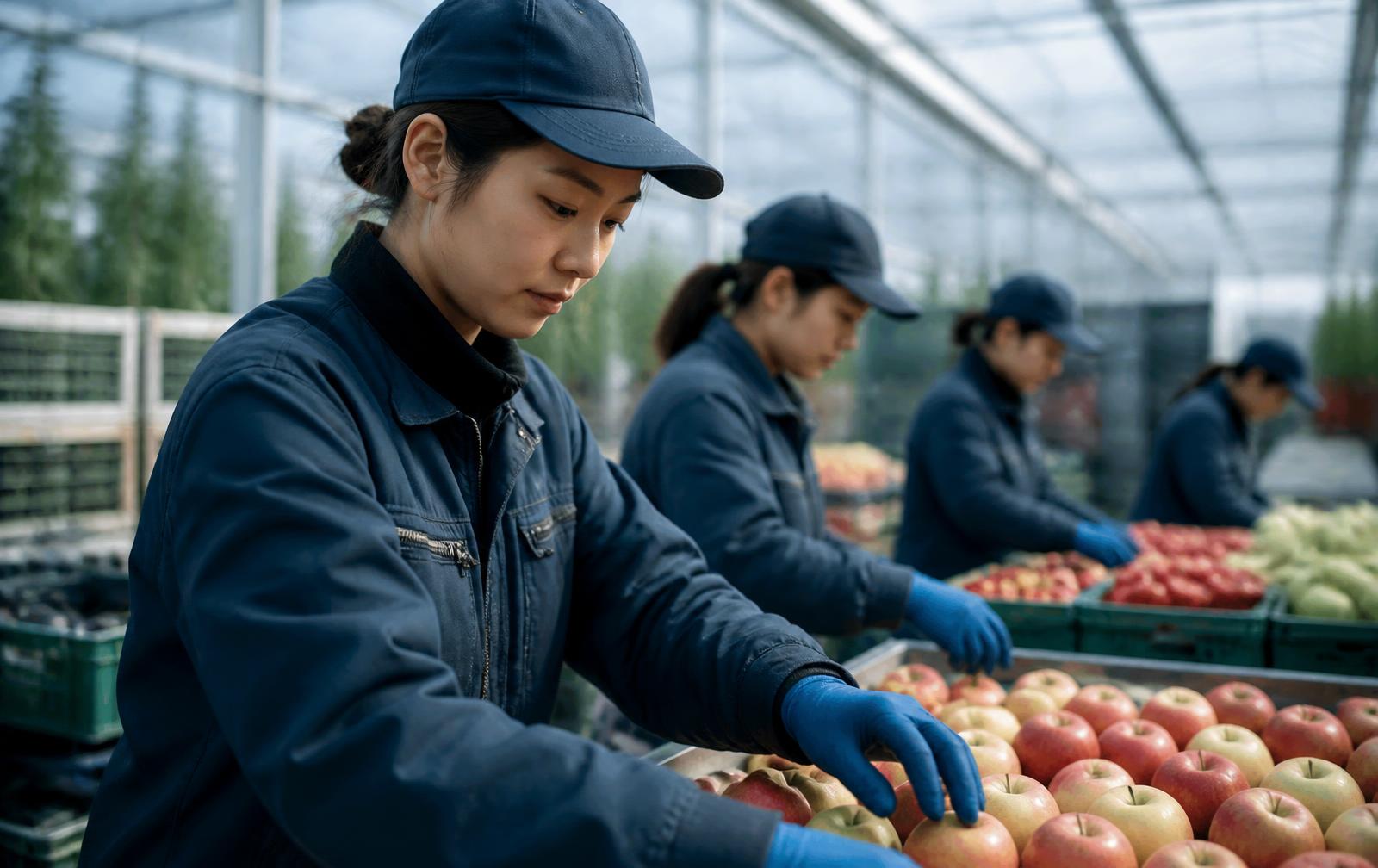
Agricultural workers from Asia for Polish farms
We recruit workers for fruit and vegetable harvesting, greenhouses and polytunnels, sorting and packing houses, cold stores, poultry farms and dairies. We run the full path: selection against real field conditions, type A and seasonal type S permits, accommodation, transport to the fields and coordinator support throughout the season.
- Arrival batches planned backwards from the first picking day
- Candidates with field, orchard and livestock experience
- Type A permits and seasonal type S permits
- Permanent recruitment, temporary work or crew outsourcing
- Scale
- from 4 to 150+ workers
- Start
- 3–5 months
- Season
- seasonal and year-round contracts
- Compliance
- Labour inspection · GLOBALG.A.P.
- Guarantee
- Worker replacement
Farming runs on a clock you cannot move
Poland is the largest apple producer in the European Union and a leading grower of vegetables, poultry and berries. All of these share one trait: the harvest window is short, and the domestic labour market no longer supplies enough hands at peak season.
4–150+
workers in a single farm project
3–5 months
from agreement to the first day of harvest
Type A / S
permanent and seasonal work permits
Housing
accommodation and field transport handled by us
Challenges farms bring to us
The season will not wait for people
Fruit ripens on its own schedule and a shortage of hands at peak harvest means crop losses you cannot recover. We plan arrival batches backwards from the first picking day.
A shrinking pool of seasonal labour
Traditional Eastern European sources no longer cover demand. Asia offers a predictable pool of candidates ready for multi-month contracts rather than a few weeks.
Harvest quality equals price
Damaged fruit loses its commercial grade, so selection covers manual dexterity and experience with delicate produce – not just willingness to do physical work.
Inspections and GLOBALG.A.P. requirements
Employment legality, working-time records and living conditions are checked during audits and labour inspections. Worker files are kept audit-ready from day one.
Who we recruit for farms
Most projects cover fruit picking and greenhouse work, but we staff the whole operation – from the field to the cold store and machinery.
Fruit picking and orchards
Apples, pears, cherries, blueberries and strawberries – hand picking, pruning, thinning and orchard maintenance work.
Field vegetable production
Planting, weeding, harvesting root and brassica crops, loading crates and irrigation work.
Greenhouses and polytunnels
Tomatoes, cucumbers, peppers, herbs and seedlings – crop training, topping, picking and work in high humidity.
Sorting and packing houses
Grading, quality selection, packing into punnets and cartons, batch labelling and preparing pallets for dispatch.
Cold stores and storage
Intake of produce, ULO chamber handling, moving crates and working in low temperatures.
Poultry farms and livestock
Poultry houses, piggeries and dairies: feeding, milking, biosecurity and cleaning work in the animal zone.
Farm machinery operators
Tractors with attachments, loaders, sprayers and trailers – after licence verification and on-farm training.
Field team leaders
Managing output targets, leading the crew, communicating with the farm owner and translating instructions for the team.
What differs between farm types
An orchard recruits differently from a greenhouse, and a seven-day livestock farm differently again. We match the candidate profile to the crop, the calendar and the working conditions.
Orchards and berry plantations
Very short picking windows and high sensitivity to quality. We plan staffing in batches with a buffer for peak season and rain delays.
Vegetable farms
Work spread from spring to late autumn with a lot of manual handling. Year-round contracts with winter storage work perform best.
Greenhouses and protected crops
Production all year, stable conditions and repeatable tasks – the most predictable segment for long-term employment.
Producer groups and packing houses
High volumes, shift work and retail chain requirements. We staff sorting, cold store and logistics as one team.
Livestock and animal farms
Seven-day operations including weekends and holidays under strict biosecurity. Candidates with livestock experience and long horizons matter most.
Mixed and arable farms
Field crops, machinery and grain storage. Here we prioritise candidates with machinery licences and readiness for the harvest campaign.
The farming season and the recruitment schedule
Permits and visas take three to four months, so harvest staffing is decided in winter. This is the rhythm we run farm projects on.
Winter – planning and paperwork
We agree the headcount for the season, file permit applications and start selection. It is the only moment when the schedule still closes without pressure.
Spring – arrivals and planting
The first batch joins maintenance and planting work, so by harvest the worker already knows the farm and its output standards.
Summer – peak harvest
Second and third batches for berry and vegetable harvests, extended working days, packing house staffing and field transport.
Autumn and winter – storage
Apple harvest, cold store intake, sorting and packing to order – the point where contracts turn into year-round employment.
Three ways to work with us
The model depends on how much HR responsibility you want to keep in house. Models can be combined – a core team employed directly and harvest peaks covered by temporary work.
Permanent recruitment
The worker is employed directly by your farm. We handle selection, legalisation and the first weeks on site.
One-off recruitmentTemporary work
Employment sits with us – the right fit for harvests and campaigns. You settle the hours actually worked.
Temporary Work AgencyCrew outsourcing
We take over a defined scope – a block of orchard, the sorting line or the packing house – including the team leader and staffing responsibility.
OutsourcingSelection against real field conditions
In agriculture workers leave not because they lack skill, but because they did not expect the weather, the pace and the length of the day at peak harvest. Our filter covers both ability and informed consent to the conditions.
Our recruitment filter
- Verified experience in agriculture, horticulture or livestock
- Readiness to work outdoors, in changing weather and bending positions
- Manual dexterity and care when picking soft fruit
- Machinery licences where the role requires them
- Acceptance of weekend work at peak season and work with animals
- Basic English or Polish for team leader positions
What we agree on your side
- Crops, acreage and the harvest calendar for the season
- Output norms, bonus rules and piece-rate settlement
- Accommodation standard, meals and transport to the fields
- Alternative work for rainy days and after the harvest
- Who delivers machinery and plant protection training
- The scope of video interviews before a decision
Legalisation and employment compliance
Documents are the longest part of the schedule, so we run them in parallel for the whole group. We operate under a KRAZ certificate and contracts compliant with Polish labour law.
Type A work permit
The standard route for year-round contracts – an application for a specific role on the farm, with a labour market test where required.
Seasonal work permit (type S)
The route for seasonal work in agriculture, horticulture and fruit growing. We choose it when the contract fits inside the harvest season.
National visa and entry
We compile visa documents, book appointments at consular posts and coordinate the group flight and airport pickup.
Residence card and extensions
For multi-year contracts we run the temporary residence and work permit application, registration and notifications to the authorities.
Details are covered in our residence and work legalisation and type A work permit services.
The first weeks on the farm
Whether a worker stays for the whole season is decided in the first month – clear output norms, decent housing and real support from the team leader.
Day 0 – arrival and housing
Airport pickup, transport to accommodation near the farm, SIM cards, first shopping and a starter briefing in the worker's language.
Week 1 – medicals and training
Occupational medicine checks, initial health and safety training, workwear, machinery, plant protection product and livestock safety rules.
Week 2 – output and pace
Work under a team leader, building up to your picking and quality standards, technique corrections and allocation to work blocks.
Month 2–3 – stabilisation
A report for the farm: output, harvest quality, absence and turnover. The coordinator supports workers with official and daily-life matters.
How a farm project runs
01 · Farm analysis
We map crops, acreage, the harvest calendar, output norms and the headcount needed to close the season without crop losses.
02 · Role profile and batch plan
We build the worker profile and a batch schedule counted backwards from the first picking day, with a buffer for paperwork.
03 · Sourcing and selection
Parallel channels in several countries, one consistent filter and video interviews with the owner or crop manager.
04 · Work legalisation
Type A or S permits, visa applications and full documentation run in parallel for the entire group.
05 · Arrival and logistics
Tickets, airport pickup, compliant accommodation, field transport and medical checks before work starts.
06 · Onboarding and support
Reaching output targets, a coordinator for the group, staffing and performance reports and a replacement guarantee.
Where we source agricultural workers from
We match the country to the crop type, contract length and harvest date. For larger farms we source in two or three countries at once.

Philippines
Strong English, plantation and packing house experience and a high standard of teamwork.

Nepal
Workers used to field work and harsh weather, focused on long contracts.

Bangladesh
A large pool of candidates for field work, sorting and packing, with high availability at peak season.

India
Experience in commercial farming and machinery, with available tractor operators and irrigation technicians.

Indonesia
Plantation and greenhouse practice, manual dexterity with soft fruit and seedlings.

Sri Lanka
Tea and vegetable plantation workers – discipline, accuracy and stable employment.
Risks we remove up front
Farm projects fail for a handful of repeatable reasons. We address each of them before the recruitment campaign starts.
Workers left idle after the harvest
We structure contracts so storage, sorting or maintenance work follows the harvest. A seasonal gap is the most common reason for costly early departures.
Non-compliant accommodation
We check housing standards before the group arrives. On-farm accommodation has to pass inspection and realistically hold people for a full season.
Weather and harvest downtime
We plan alternative work – sorting, warehouse, maintenance – so a rainy week does not mean lost pay and a frustrated crew.
Unrecognised machinery licences
Documents issued abroad are verified before departure and recognition in Poland is planned before anyone gets on a tractor.
Frequently asked questions about farm workers
Which agricultural roles do you recruit from Asia?
Fruit and vegetable pickers, greenhouse and polytunnel staff, sorting and packing house teams, cold store operatives, tractor and farm machinery operators, poultry farm, piggery and dairy workers, plus field team leaders.
Which countries do you source farm workers from?
Mainly the Philippines, Nepal, Bangladesh, India, Indonesia and Sri Lanka. Nepal and Bangladesh work well for field and orchard work, while the Philippines and India offer more candidates with livestock and machinery experience and better English.
Does international recruitment make sense for seasonal work?
Yes, if you plan ahead. Work permits and visas take three to four months, so a harvest campaign starts in winter or early spring. For short peaks, temporary work or an outsourced crew with a team leader is the better fit.
Which permits are required for farm work in Poland?
Usually a type A work permit and a national visa, and for seasonal work a type S seasonal work permit. We match the route to the contract length and type of work, file the applications and track extension deadlines.
Do candidates have farm machinery experience?
Some do – tractor driving, loaders, sprayers and irrigation systems. We verify licences and plan recognition or retraining in Poland, because documents issued abroad are not always accepted here.
Who provides accommodation on the farm?
Most often the farm provides housing and we take responsibility for the standard, agreements and equipment. If you have no facilities, we arrange accommodation nearby and transport to the fields.
What about livestock work and veterinary requirements?
Poultry farms, piggeries and dairies run strict biosecurity: zoned clothing, hygiene locks, movement restrictions and training. Candidates are briefed before departure; the on-the-job instruction is delivered by the farm under its own procedures.
What is the minimum number of workers per project?
We start from four people. In agriculture we usually run batches of 8–30 workers for a specific harvest, and for large farms or producer groups we staff teams of over 100.
Can Asian workers handle outdoor work in the Polish climate?
We present the conditions honestly before departure: temperature, rain, bending work and long days at peak harvest. A candidate who accepts that at interview stage stays for the whole season.
Can you also staff the sorting and packing house?
Yes, and we usually do. Harvesting without packing does not close the chain, so we plan field, sorting, storage and cold store staffing as one project with one batch schedule.
How much does recruiting a farm worker cost?
Pricing depends on the source country, headcount, contract length and the scope of post-arrival support. We quote a per-worker cost split into recruitment, legalisation, flights and ongoing service – with no hidden items.
What if a worker does not perform at harvest?
We provide a replacement guarantee. In practice we monitor output for the first two weeks, move the worker to other tasks on the farm – sorting, machinery, warehouse – and only then send a new candidate.
We will staff your harvest on time.
We reply within 48 hours with a recommended sourcing country, a batch plan built around your harvest calendar and a full per-worker cost breakdown – with no commitment.