
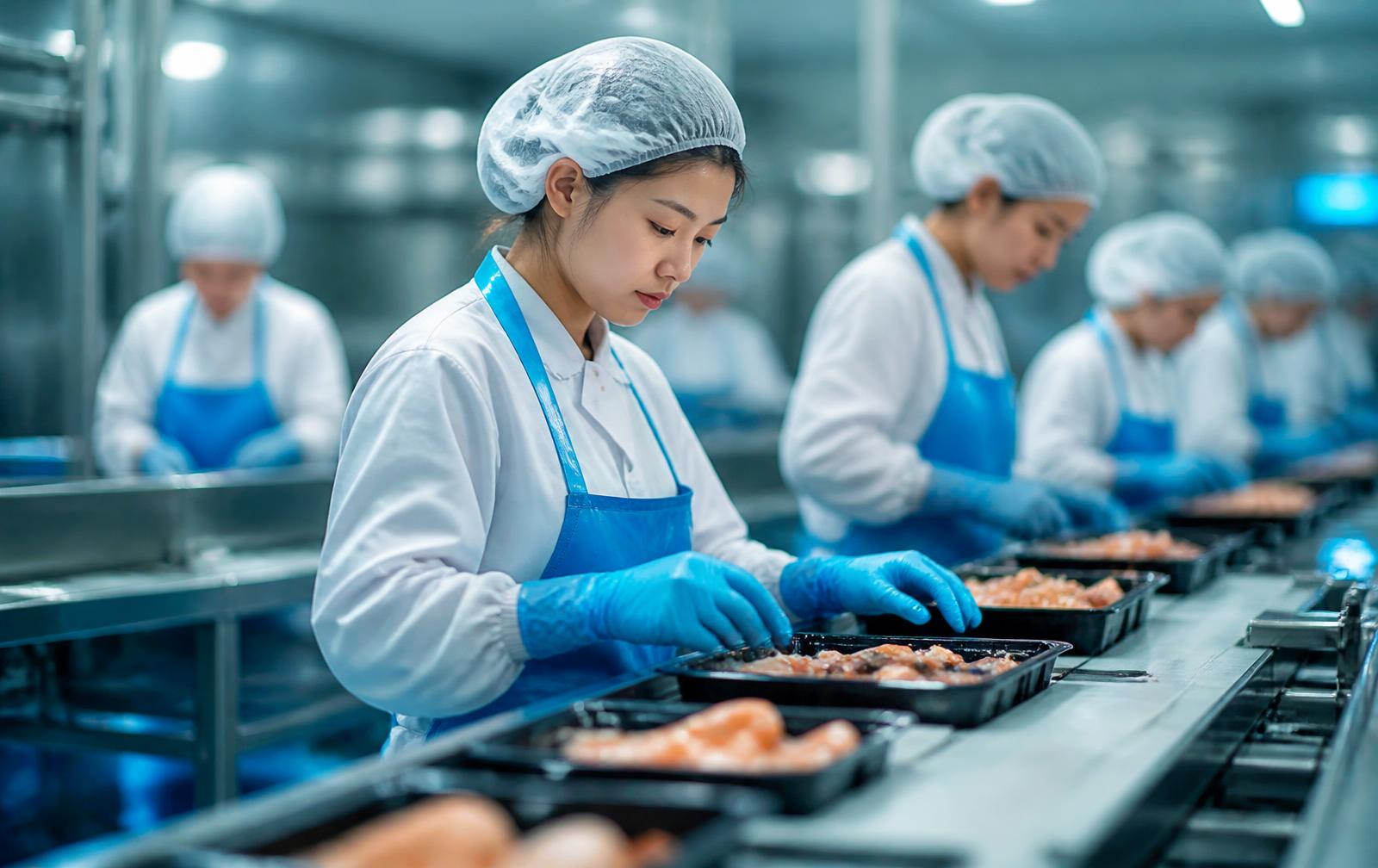
Food processing workers from Asia
We recruit meat cutting and deboning staff, slaughterhouse crews, packing line operators, cold store, sorting and sanitation teams for Polish meat plants, dairies, fish and vegetable processors and industrial bakeries. We run the full path: selection, work legalisation, sanitary-epidemiological clearance, housing and onboarding aligned with your HACCP system.
- Complete crews staffed, not single vacancies
- Candidates with hands-on meat, fish and poultry experience
- Sanitary health checks and audit-ready worker files
- Permanent recruitment, temporary work or an outsourced crew
- Scale
- from 4 to 200+ people
- Start
- 3–5 months
- Shifts
- 3 shifts, weekends included
- Compliance
- HACCP · IFS · BRC
- Guarantee
- Worker replacement
Food processing is an industry that cannot stop
Poland is one of the largest food producers in the EU and its plants run continuously. At the same time this is the sector with the highest turnover – cold, humidity and conveyor pace mean the domestic market cannot fill the shifts, especially in cutting rooms and at night.
4–200+
workers in a single contract
3–5 months
from contract to the first shift on the line
3 shifts
night and weekend coverage included
Health checks
sanitary clearance before entering the hall
Challenges plants bring to us
The highest turnover in industry
Cold, damp and line pace mean food plants lose people faster than they can train them. International recruitment gives you staffing planned in quarters, not weeks.
Seasonal production peaks
Fruit and vegetable campaigns, holidays and export orders can double headcount needs within weeks. We plan batches ahead against your production calendar.
Line output equals its weakest station
Gaps in cutting or packing stop the whole line. That is why we staff complete crews rather than single vacancies.
Sanitary rigour and audits
IFS, BRC, HACCP and sanitary inspections leave no room for improvisation. Worker documentation – health checks, training, legalisation – must be complete from day one.
Who we recruit for food plants
Most projects cover meat cutting and packing lines, but we staff the whole plant – from raw material sorting to sanitation between shifts.
Meat cutting and deboning
Trimming, separating meat from bone, sorting cuts – the key and hardest-to-fill group in meat plants.
Slaughterhouse operations
Slaughter line work, evisceration, chilling and carcass handling under veterinary supervision.
Packing line operators
Tray sealers, vacuum packers, labellers and scales, checking weights and seal integrity.
Portioning and palletising
Building sets, bulk packing, batch marking and preparing pallets for dispatch.
Cold store and freezer staff
Picking and moving goods in sub-zero temperatures, operating trucks and racking in chilled zones.
Fruit and vegetable sorting
Grading, quality selection, peeling and preparing raw material for further processing.
Fish and poultry processing
Filleting, gutting, portioning and packing – where Asian candidates bring the most hands-on experience.
Sanitation and industrial cleaning
Washing and disinfecting lines between shifts, CIP systems, work under chemical and safety regimes.
What is specific about each type of plant
Recruiting for a slaughterhouse differs from a dairy, and both differ from a seasonal vegetable processor. We match the candidate profile to the raw material, temperature and production rhythm.
Meat and poultry plants
Slaughter, cutting, deboning and packing. The highest demand and the longest training curve – so selection is based on proven knife experience.
Fish and seafood processing
Filleting, portioning and packing. Candidates from the Philippines, Vietnam and Indonesia reach full speed faster than any other origin.
Dairies and cheese production
Line operation, moulding, ripening rooms and packing. Very high hygiene rigour and continuous operation, weekends included.
Fruit and vegetable processing
Sorting, peeling, freezing and preserving. Strongly seasonal – usually delivered through temporary work or outsourced crews.
Industrial bakeries and confectionery
Night work, ovens and packing lines, decorating and portioning products at conveyor pace.
Ready meals and industrial catering
Meal preparation and portioning, modified atmosphere packing lines, weight and label control.
Hygiene, health checks and audit readiness
In food processing it is documentation, not willingness, that clears a worker for the hall. We close all health checks and training before anyone enters production.
Sanitary-epidemiological examinations
Full health checks and an occupational health certificate before any contact with food. We book appointments and drive workers to the clinics.
Safety training and job induction
Initial safety training on our side, station induction on the plant side – with bilingual instructions and pictograms for each production zone.
HACCP, GMP and GHP rules
Candidates learn production hygiene basics before departure in their own language; full procedures are delivered by your plant under its own system.
Audit-ready worker files
Contract, legalisation, health checks, training and working time records kept in one file – ready for IFS/BRC audits and labour inspections without follow-ups.
Three cooperation models
The model depends on how much HR responsibility you want to keep in-house. Models can be combined – a core crew employed directly, seasonal peaks covered by temporary work.
Permanent recruitment
The worker is employed directly by you. We handle selection, legalisation, health checks and the first weeks on the line.
One-off recruitmentTemporary work
Employment on our side – ideal for seasonal campaigns and holiday peaks. You settle actual hours worked.
Temporary Work AgencyCrew outsourcing
We take over a defined scope – packing or sanitation, for example – with a team leader and full staffing responsibility.
OutsourcingSelection built around real conditions on the floor
In food processing candidates leave not because they cannot do the job, but because they did not expect the conditions. Our filter therefore covers both skills and readiness for cold, damp and conveyor pace.
Our recruitment filter
- Proven processing experience: meat, fish, poultry or packing lines
- Readiness for cold, damp conditions and a three-shift system
- Manual dexterity and work pace verified in documents and references; optional practical test as a paid add-on on client request
- No health contraindications for working with food
- Dietary and religious declarations matched to the plant profile
- Communicative English or basic Polish for team leader roles
What we agree on your side
- Production zones, temperatures and required clothing
- Raw material: pork, beef, poultry, fish, dairy
- Shift system, output standards and bonus rules
- Accommodation standard and transport for night shifts
- Who runs the station induction and HACCP training
- Scope of video interviews with your production manager
Legalisation and employment compliance
Paperwork is the longest part of the schedule, so we run it in parallel for the whole group rather than candidate by candidate. We operate under a KRAZ certificate and contracts compliant with Polish labour law.
Type A work permit
Filed for the specific role in your plant, with a labour market test where required and accounting for the shift system.
National visa and entry
We compile visa documents, book appointments at the consulates and coordinate the group's flights and airport pickup.
Residence card and legal stay
After arrival we handle the temporary residence and work permit application, registration and notifications to the authorities.
Audit-ready documentation
Contracts, working time records, sanitary health checks and training in one file – ready for labour, sanitary and IFS/BRC audits.
More details in our residence and work legalisation and type A work permit services.
The first weeks on the line
Whether a worker stays is decided in the first month – health checks, clear hygiene rules and real support from the team leader at conveyor pace.
Day 0 – arrival and housing
Airport pickup, transport to accommodation near the plant, SIM cards, first shopping trip and a briefing in the worker's language.
Week 1 – health checks and training
Sanitary-epidemiological and occupational health checks, initial safety training, workwear and PPE, hygiene zone induction.
Week 2 – entering the line
Work under a team leader, building up pace and quality to your standards, correcting technique in cutting and packing.
Month 2–3 – stabilisation
Report for the plant: output, defects, absence and turnover. A coordinator supports workers with official and daily matters.
How a food plant project runs
01 · Plant and staffing analysis
We map zones, roles, the shift system, output standards and the headcount needed for the line to run at full capacity.
02 · Job card and batch plan
We build the worker profile and a batch schedule counted backwards from your campaign or line start date.
03 · Sourcing and selection
Parallel channels in several countries, one consistent filter and video interviews with your production manager. Practical tests are available only as an optional paid add-on on client request.
04 · Work legalisation
Type A permits, visa applications and full documentation run in parallel for the whole group.
05 · Arrival, health checks and logistics
Tickets, airport pickup, housing, shift transport and sanitary clearance before entering the hall.
06 · Onboarding and care
Running-in on the line, a coordinator for the group, output and staffing reports plus a worker replacement guarantee.
Where we source food processing workers
The country is matched to the raw material, language requirements, religious considerations and your deadline. For larger contracts we source in two or three countries at once.

Philippines
Experience in fish, poultry and ready meal processing, very good English and strong teamwork culture.

India
The largest candidate volumes for line work, packing and chilled warehouses.

Nepal
Workers focused on long contracts, coping well with shift work and low temperatures.

Bangladesh
A large pool of candidates for line work, sorting and portioning, with high availability.

Indonesia
Experience from fish and seafood plants, strong manual skills in filleting and portioning.

Sri Lanka
Workers from tea, fish and vegetable processing – work discipline and stable employment.
Risks we remove up front
Food processing projects fail for a handful of recurring reasons. We address each of them before the recruitment campaign starts.
People leaving after the first week in the cold
We show candidates the real conditions – temperature, humidity, line pace and shift length – before departure, including photos of the hall. It is the most effective filter in this industry.
Religious or dietary conflict
We establish the plant's raw material profile at the start and choose the sourcing country so that working with pork or beef is never a surprise.
Documentation gaps during inspections
Health checks, training and legalisation run in parallel for the whole group, and worker files are kept audit-ready at all times.
Output below line standards
We monitor output and quality for the first two weeks, move the worker to a better-matched station and, as a last resort, use the replacement guarantee.
Photos from food processing plants
Clean-zone work and production lines – protective clothing and sanitary standards.
Frequently asked questions about food processing workers
What kind of workers do you recruit for food processing?
Meat cutting and deboning staff, slaughterhouse line workers, packing and portioning line operators, cold store and freezer staff, fruit and vegetable sorting, fish and dairy processing, plus industrial bakeries. We also place team leaders, industrial cleaning (sanitation) crews and quality control staff.
Which countries do you source food plant workers from?
Most often the Philippines, India, Nepal, Bangladesh, Indonesia and Sri Lanka. For meat cutting, candidates from the Philippines and Vietnam with fish and poultry processing experience perform best, while Nepal, Bangladesh and Uzbekistan work well for line and cold store roles.
Can Asian workers handle cold stores and freezers?
Yes, but we treat it as a separate recruitment profile. The conditions – temperature, clothing, shift length and warm-up breaks – are described to the candidate before departure and we verify prior experience in low temperatures. This is the main reason people leave in this industry, so we never leave it to chance.
How do you handle sanitary and epidemiological health checks?
Before being allowed to work with food, every worker completes sanitary-epidemiological examinations and receives an occupational health certificate. We book appointments, drive workers to clinics and make sure the paperwork is complete before the first shift.
Do the workers know HACCP and GMP rules?
Basic production hygiene is covered in pre-departure materials in the worker's own language, but full HACCP, GMP and GHP training is delivered by your plant under its own procedures. We prepare bilingual instructions and pictograms so the on-the-job induction runs smoothly.
How long does it take from contract to the first shift?
Realistically 3–5 months. Selection and interviews take 2–4 weeks, the work permit and visa 3–4 months, and health checks, training and running-in on the line take the first 2 weeks after arrival.
Are religion and diet an issue in a meat plant?
It is a real issue and we settle it up front. Some Muslim and Hindu candidates will not work with pork or beef. We establish the plant's raw material profile before the campaign and choose the sourcing country so that nobody is disappointed after arrival.
Do you arrange accommodation near the plant?
Yes. We organise housing that meets legal standards, transport to shifts including nights, and coordinator support. In food plants running three shifts, transport matters just as much as the accommodation itself.
What is the minimum number of workers per project?
We start from 4 people, but in food processing we usually work in batches of 10–30, because a production line needs a full crew at once. Our largest contracts cover crews of over 100 people.
Who provides workwear and protective equipment?
Workwear and PPE according to the production zone standard are provided by the plant – it is part of the food safety system. We collect sizes before arrival so the worker can enter the hall on day one.
Is seasonal hiring for a campaign possible?
Yes. For fruit and vegetable campaigns or pre-holiday peaks, temporary work or an outsourced crew works best – you settle actual hours worked while we handle staffing and replacements.
What if a worker cannot keep up with the line?
The contract includes a replacement guarantee. In practice we monitor output and quality for the first two weeks, move the worker to a better-matched station within the plant, and if that does not help we send another candidate.
We will staff your production line.
We reply within 48 hours with a recommended sourcing country, a batch plan aligned to your production calendar and a full cost-per-worker calculation – no obligation.