
The lowest turnover
Nepalese workers sign long contracts and rarely change employer. This is the destination for companies that want to build a permanent team, not patch gaps every season.

 Recruitment from Nepal
Manufacturing, warehousing, construction and HoReCa – candidates with experience from Qatar, the Emirates and Malaysia, known for loyalty and the lowest turnover among Asian destinations. We run the entire process: recruitment in Kathmandu, the work permit, labour approval, the visa and onboarding at your plant – usually in 4–5 months.
Nepal · South Asia
Working abroad is common and well organised in Nepal: more than two million people currently work in Qatar, the United Arab Emirates, Saudi Arabia, Malaysia and South Korea. For a Polish employer this means access to candidates who are not learning shift work and safety procedures from scratch – they have already done exactly that, only in a far harsher climate.
This destination is chosen above all by manufacturing plants and warehouses that need a stable team. Nepalese workers are known for loyalty and rarely change jobs mid contract. The trade-off is a slightly longer process: alongside the Polish work permit you need an exit approval issued in Kathmandu, and the candidate files the visa application at the Polish Embassy in New Delhi. We run both tracks in parallel – one timeline, one budget, one coordinator.
4–5
months from contract to arrival
100%
legal employment and residence
2.2 m
Nepalese currently working abroad
1–4
NSTB skill test levels
Other directions
We also recruit from Philippines, India, Bangladesh, .
See all directionsBenefits
Nepalese workers sign long contracts and rarely change employer. This is the destination for companies that want to build a permanent team, not patch gaps every season.
Perseverance, composure and respect for supervisors – the qualities Nepal has been known for since the Gurkha era – translate in practice into a team without friction on the shop floor.
The national vocational education system, with skill tests at levels 1–4, allows qualifications to be verified by documentation before the employer interview.
Millions of Nepalese have worked in Qatar, the UAE, Saudi Arabia, Malaysia and Korea. They know shift work, health and safety rules and the quality standards of large plants.
English is the language of instruction in technical education, and candidates pick up basic Polish efficiently – instructions and safety rules work from day one.
If a worker does not meet expectations during the trial period, we provide a free replacement.
Qualifications
The Nepalese qualification system is transparent and can be verified by documentation. Every profile you receive includes a scan of the diploma or certificate, employment certificates from previous contracts and an assessment of English level.
CTEVT
Council for Technical Education and Vocational Training – the national vocational education system. A CTEVT diploma is the primary proof of technical education in trades such as electrician, mechanic or construction technician.
NSTB skill tests (levels 1–4)
The National Skill Testing Board awards levels confirming real proficiency in a trade: welding, masonry, fitting, installations. The level translates directly into which position a candidate suits.
Gulf and Malaysia references
Employment certificates from Qatar, the UAE, Saudi Arabia and Malaysia – confirmation of work under a strict safety regime, on shifts and to the quality standards of large industrial plants.
The region of origin genuinely affects the professional profile and language – we match it to the position.
Kathmandu Valley
Technical staff, electricians, mechanics, hotel personnel and catering – the highest share of English speakers.
Pokhara and the Gandaki region
Hospitality, catering, guest services and workers with Gulf experience.
Terai: Chitwan, Birgunj, Biratnagar
Manufacturing, food processing, warehousing and logistics – the industrial region along the Indian border.
Gorkha, Dhading and the hill districts
Construction, groundworks and physical roles – candidates used to demanding conditions and teamwork.
We run the process in six stages: call, quote and contract, recruitment in Kathmandu, the Polish work permit, Nepalese labour approval, the D visa filed in New Delhi and relocation. Each stage has a clear timeframe and a complete document set – below we show step by step what happens, how long it takes and who covers the costs.
4–5 mo.
from contract to first day of work
6 stages
one coordinator manages the whole process
100%
compliance with Polish and Nepalese requirements
Process stages
Needs analysis, position profile, quote and timeline. The process starts only once the contract is signed – that is always the first step.
Call and needs analysis
Week 1We agree the scope of duties, required qualifications, pay, shift system and accommodation conditions.
Quote and timeline
Week 1–2We present the full budget, the dates of each stage and the planned arrival batches.
Contract and demand letter
Week 2The employer contract and the demand letter in English – this document opens the procedure on the Nepalese side.
Sourcing and verification of candidates by a licensed agency: experience, references and CTEVT/NSTB certificates.
Pre-selection with a licensed partner
Week 2–4An agency licensed by the Department of Foreign Employment sources candidates and verifies references from Gulf and Malaysian contracts.
Shortlist and candidate selection
Week 3–5We present a shortlist of verified profiles. The decision belongs to the company. Video interviews are arranged on request; practical tests are a paid add-on.
Documentation, labour market test and application at the voivodeship office – in parallel with recruitment in Nepal.
Compiling documentation
Week 3–4Company data, employment conditions and declarations – checked for compliance before the application is filed.
Labour market test
Week 4–7Where the position requires it: posting the vacancy at the district labour office and obtaining the starost's opinion.
Decision: type A permit
Week 4–12Application at the voivodeship office; a decision typically takes 30–60 days depending on the region.
Demand letter, contract and power of attorney, and consent of the Department of Foreign Employment.
Labour approval
Week 10–15Application at the Department of Foreign Employment with the contract, demand letter and power of attorney. Without this consent the worker cannot leave Kathmandu airport.
Complete documents, medical checks and the candidate's trip to New Delhi – applications from Nepalese citizens are handled by the Polish Embassy in India.
Documents and medical checks
Week 12–16Passport, medical examination at an accredited clinic, travel insurance and the documents required by the consulate.
Trip to New Delhi and visa application
Week 14–20Applications from Nepalese citizens are accepted by the Polish Embassy in New Delhi. We plan the appointment, travel and accommodation and prepare the candidate for the visit.
Flights from Kathmandu, accommodation, PESEL number, bank account and onboarding at the workstation.
Tickets and transfer
Week 18–22Flight booking from Kathmandu (usually with a Gulf connection), airport transfer and group pick-up by the coordinator.
Accommodation and registration
First weekHousing compliant with sanitary requirements, address registration, PESEL application and a bank account.
Safety training and onboarding
First weekHealth and safety training and instructions in English, an assigned buddy on the floor and first days supervised by a foreman.
Aftercare and 90-day review
Month 1–3Support with residence matters and a review of the cooperation after three months.
Typical timeline
From contract to the first day of work – usually 3–5 months
Call, quote and contract
01Recruitment and pre-selection in Kathmandu
02Type A work permit
03Labour approval
04National D visa in New Delhi
05Arrival and first day of work
06Cost of employment
Official fees in Poland
EmployerType A work permit application, visa fee and the service fee of the visa application centre.
Procedure on the Nepalese side
Employer / agencyLabour approval at the Department of Foreign Employment.
Candidate documents and medical checks
Employer / agencyCompiling the documents required by the office and consulate plus medical examinations at an accredited clinic in Kathmandu.
Visa trip to New Delhi
EmployerTravel, accommodation and support for the candidate while submitting the visa application in India – an item specific to this destination.
Flight and relocation
EmployerFlight ticket from Kathmandu, airport transfer, first accommodation and a starter kit.
Agency fee
EmployerRecruitment, managing the official process on both sides and coordinator aftercare following arrival.
We do not quote a single price per worker – the budget depends on the position, headcount and region. It always consists of the same items, however, so you can compare agency offers without hidden costs. Nepal adds one element that is easy to forget: the candidate's trip to New Delhi to submit the visa application. We include it in the quote from the very beginning.
Ready to start
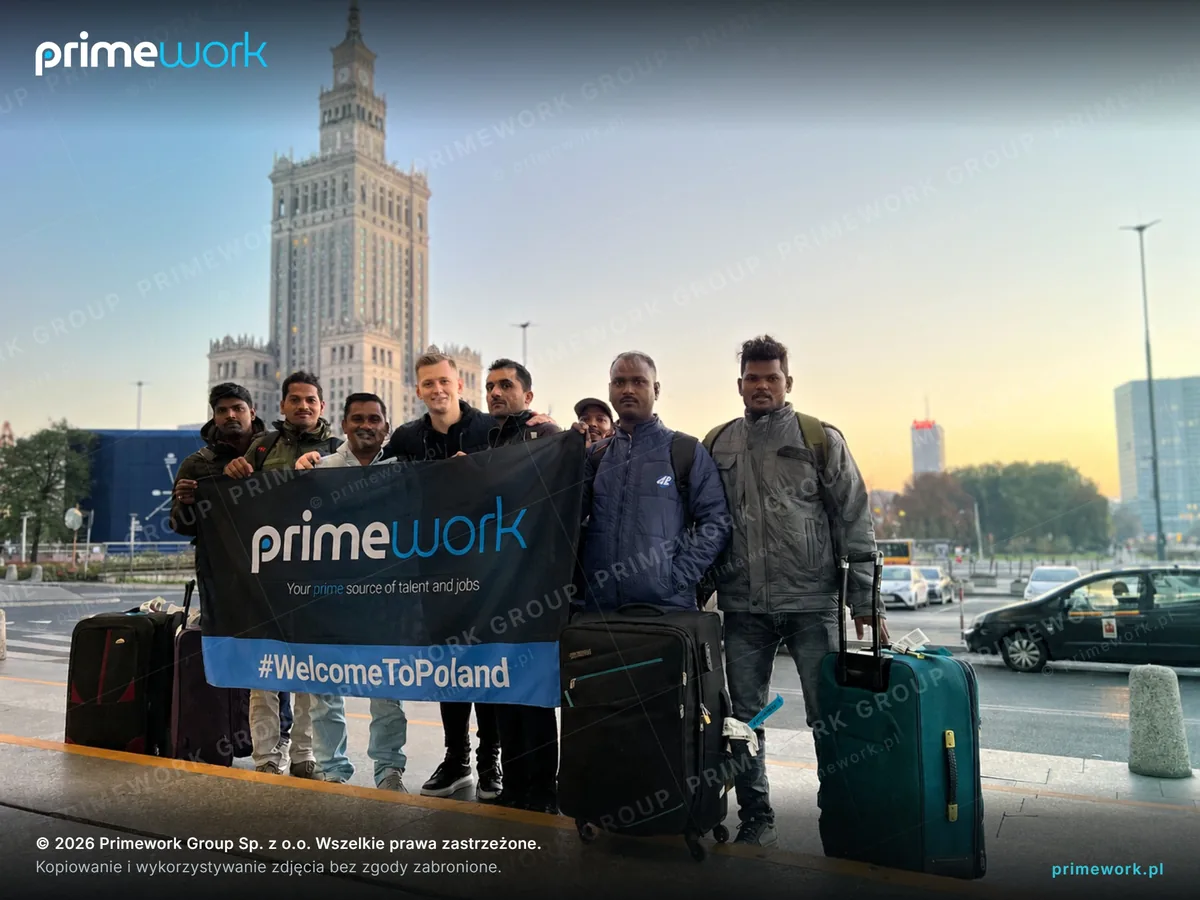
Selected photos from our work: arrivals, onboarding and day-to-day support for groups from Nepal.
Where Nepali workers excel
Positions
The strongest side of this destination are roles that require regularity and teamwork: manufacturing, warehousing, processing and construction. Technical profiles with an NSTB skill test are available too. Practical tests are arranged in Kathmandu at the employer's request – as a paid add-on.
Looking for technical staff with welding certificates? See also workers from India or workers from the Philippines.
A comparison of typical differences in the process and candidate profile.
| Criterion | Nepal | Other destinations |
|---|---|---|
| Candidate profile | Stable production, warehouse and construction staff | More often narrow technical specialisations |
| Turnover and contract length | Very low turnover, multi-year contracts | Higher turnover in the first year |
| Process duration | 4–5 months | 1–4 months (visa-free destinations) |
| Specific formalities | Labour approval and a D visa filed in New Delhi | Permit or declaration |
| English proficiency | Basic to good, depending on the region | Varied |
Cultural integration
Nepalese teams settle in calmly and without friction, but the first weeks decide whether a worker stays for years. A few simple organisational decisions shorten onboarding and noticeably reduce turnover in the first year.
Language barrier on the floor
Instructions and safety rules in English, pictograms and a foreman-interpreter in every larger group.
First winter and acclimatisation
A winter clothing pack, a briefing on weather and commuting, and coordinator support during the first weeks after arrival.
Cuisine and daily habits
Access to a private kitchen in the accommodation, a beef-free option in the canteen and accounting for the Dashain festival in the holiday schedule.
Family contact and finances
Help opening a bank account and arranging low-cost transfers to Nepal, plus stable internet in the accommodation – this genuinely reduces turnover.
Short answers to questions about recruiting workers from Nepal.
Nepalese workers have spent decades on contracts in Qatar, the United Arab Emirates, Malaysia and South Korea, so they know shift work, strict health and safety regimes and life away from home. Employers consistently point to three things: very low turnover, a calm approach to physical work and loyalty to the company. This is a destination for plants that want a stable, long-term team rather than seasonal cover.
1) Needs analysis, quote and contract with the employer, 2) pre-selection by a licensed agency in Kathmandu – verification of experience, references and CTEVT/NSTB certificates, 3) type A work permit at the voivodeship office, 4) labour approval at the Nepalese Department of Foreign Employment, 5) candidate preparation and the national D visa – applications from Nepalese citizens are handled by the Polish Embassy in New Delhi, 6) arrival, accommodation, registration, PESEL number and onboarding at the plant.
Realistically 4–5 months from signing the contract to the first day of work. The longest stages are the work permit (usually 30–60 days), the labour approval procedure on the Nepalese side and the visa appointment in New Delhi. With larger groups the stages overlap, so subsequent batches arrive faster.
Poland does not run a national visa application point in Kathmandu. Applications from citizens and residents of Nepal are handled by the Polish Embassy in New Delhi together with the VFS Global application centre. This means the candidate must travel to India to submit documents and biometrics. We plan this stage in advance: appointment, transport, accommodation and a complete document set – this is where inexperienced agencies most often lose weeks.
English is the language of instruction in a large share of Nepalese schools and on technical programmes, and candidates with Gulf experience use it on construction sites and production floors. The level varies – we always verify it during the interview and describe it in the candidate profile. Nepalese workers also pick up basic Polish quickly.
Labour approval (Nep. Shramik Swikriti) is the consent of the Nepalese Department of Foreign Employment for a specific person to travel to a specific employer. Without it the worker will not be allowed to leave Kathmandu airport, even with a valid visa. The application requires, among others, a demand letter from the employer, an employment contract and a power of attorney. We handle it together with a licensed agency in Kathmandu.
The basis is the CTEVT system (Council for Technical Education and Vocational Training) and NSTB skill tests with levels 1–4 – for welders, electricians, masons, fitters and mechanics. On top of that come certificates and references from contracts in Qatar, the UAE and Malaysia. We verify qualifications by documentation before presenting a candidate; practical tests are a paid add-on, arranged in Kathmandu at the employer's request.
The budget consists of official fees (work permit, visa fee, VFS), the cost of the Nepalese procedure (labour approval, medical checks), the candidate's trip to New Delhi for the visa, the flight ticket and the agency fee. We present a precise calculation for a specific position and headcount in the offer before we start – with no hidden items.
Yes. Pay and other employment conditions must be no worse than for Polish employees in a comparable role – this is a condition for issuing the work permit and a point checked by the Labour Inspectorate and Border Guard. In addition, Nepalese foreign employment rules require the contract terms to match those declared in the labour approval procedure.
Manufacturing and processing, warehousing and logistics, construction and finishing works, hospitality and catering, and machine operation. These are sectors where regularity, shift work and readiness for a long contract matter – and that is exactly where this destination stands out.
Accommodation provided by the employer or the agency is the standard. We arrange tickets, airport transfer, housing that meets sanitary requirements, registration, a PESEL number and a bank account. We also suggest simple cultural solutions: access to a private kitchen, accounting for the Dashain festival in the holiday schedule and appointing a foreman-interpreter in larger groups.
Within the agreed trial period we provide a free replacement. Throughout the contract, one coordinator supports the company and the team, addressing problems before they turn into turnover.
Destination: NepalWe start with a conversation about your needs, a quote and a contract. Only then do we launch recruitment in Kathmandu, the work permit, the labour approval and the visa in New Delhi – with an agreed arrival schedule.
Realistic time from contract to first day of work: 4–5 months.