
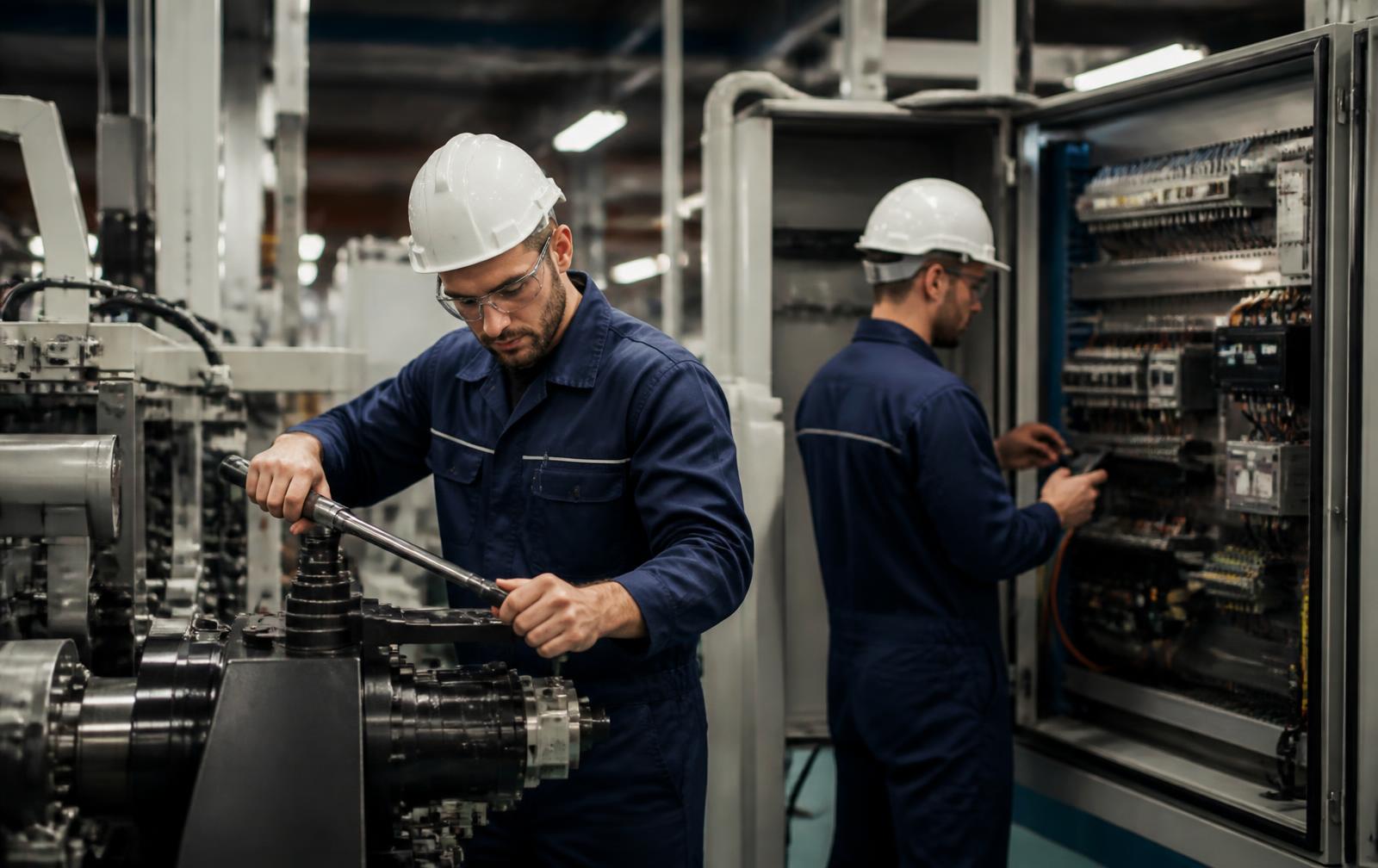
Asian workers for maintenance in Polish plants
We recruit technical staff for manufacturing plants across Poland. The candidate profile is built around your machine park – specific machines, control systems and maintenance scope – rather than a generic job title. We run technical pre-selection, full legalisation, flights and housing, and onboarding in pairs with your own technicians.
- Preventive inspections, breakdowns, electrical work and automation
- Readiness for shift work and emergency duty
- SEP and UDT courses arranged after arrival in Poland
- Permanent recruitment, temporary work or crew outsourcing
- Scale
- 2 to 20 people per plant
- Start
- 3–5 months
- Work system
- 1, 2 or 3 shifts + duty
- Models
- Permanent · TWA · outsourcing
- Guarantee
- Worker replacement
Maintenance is the hardest hire in manufacturing today
Plants compete for the same narrow pool of mechanics and industrial electricians. Raising the rate works only briefly, because next year the same person receives a better offer from the factory next door. International recruitment opens a market where technicians are simply more available.
2–20
technicians in a typical single-plant project
3–5 mo.
from contract to the first day on the floor
24/7
coverage of shift work and emergency duty
20+
countries we recruit from
What technical departments come to us with
No technicians on the local market
Mechanics and industrial electricians are the hardest group to hire in manufacturing. Local recruitment usually means poaching from competitors at an ever higher rate.
Unstaffed night shifts and duty rosters
One vacant maintenance shift means a night breakdown waits until morning and the line stands still for hours longer than it should.
Rising cost of downtime
An hour of stopped production costs many times more than a technician's salary. A stable technical team is the cheapest insurance for output.
Overloaded team and burnout
When two people do the work of four, preventive maintenance disappears and only firefighting remains – a straight path to turnover across the department.
Who we recruit in Asia for maintenance departments
Most enquiries concern mechanics and industrial electricians. We also fill roles that require licences – those follow a separate selection path and courses after arrival in Poland.
Maintenance mechanic
Preventive inspections, component replacement, diagnostics and mechanical breakdown repair on production lines.
Industrial electrician
Installations and control cabinets, drives, sensors and wiring replacement, work under a licensed electrician's supervision.
Automation technician
PLC and inverter handling, control system diagnostics, support during line modernisations.
Machine setter
Changeovers, parameter setting, first-piece checks and reduction of changeover times.
Hydraulics and pneumatics mechanic
Power systems, cylinders, compressors, hoses and fittings – replacements, leak control, servicing.
Technical assistant
Support for the maintenance crew: workshop work, lubrication, minor repairs, spare-parts store.
Three ways to work with us
The model depends on how much HR responsibility you want to keep in-house. They can be combined – a core team employed directly, with shutdowns covered by temporary work.
Permanent recruitment
The technician is employed directly by you. We handle selection, legalisation, arrival and the first weeks of adaptation.
One-off recruitmentTemporary work
Employment stays on our side and you pay for hours worked – the natural model for shutdowns and modernisation projects.
Temporary Work AgencyCrew outsourcing
We take over a defined scope of technical work together with a team leader, duty roster and responsibility for the result.
Worker outsourcingPre-selection against your machine park
Candidates go through pre-selection: document verification and a technical interview about the machines they worked on. Practical and language tests are an optional paid add-on, run whenever you request them.
Our recruitment filter
- Documented experience in maintenance, service or an industrial workshop
- Technical education: mechanics, electrical engineering, mechatronics or automation
- Video interview covering specific machines, breakdowns and inspection scope
- Ability to read technical drawings and electrical schematics
- Declared willingness to work shifts and emergency duty
- Verification of ID documents, diplomas and previous work abroad
What we agree on your side
- Machine types, manufacturers and age of the machine park
- Control systems: PLC, HMI, inverters, robotics
- Split between preventive work and breakdown response
- Shift system, duty roster and overtime rules
- Required English level and language of documentation
- Housing standard, transport and distance from the plant
Courses and licences after arrival in Poland
Foreign technical licences do not transfer one-to-one into Polish regulations. That is why the course plan is part of the project schedule, not an afterthought.
SEP electrical licence up to 1 kV
Foreign electrical licences are not recognised automatically in Poland. Candidates are enrolled in a SEP course and exam, usually within the first weeks after arrival.
UDT licences for forklifts and platforms
If a technician is to drive a forklift or work from a mobile platform, we arrange the Polish UDT course and exam.
Medical checks and safety training
Pre-employment medical checks, including work at height where required, plus health and safety and job-specific training with interpretation.
LOTO procedures and instructions
Lockout/tagout procedures and workstation instructions are prepared bilingually so safety rules are clear from day one.
Legalisation and employment compliance
Documents are the longest part of the schedule, so we run them in parallel for the whole group. We operate under a KRAZ certificate and contracts compliant with Polish labour law.
Type A work permit or declaration
The route depends on citizenship and the role. Cases are run in parallel for the whole group, not candidate by candidate.
Visas and arrival
Visa applications, consulate appointments, tickets and an arrival schedule matched to your inspection and shutdown plan.
Residence cards and extensions
We track deadlines so the continuity of legal employment is never interrupted during the contract.
Audit-ready documentation
A complete document set for every worker, notifications to the authorities and a deadline register ready for inspections.
Details are described in residence and work legalisation and type A work permit.
How a maintenance project runs
01 · Machine park audit
We map machine types, control systems, preventive maintenance scope, shift system and the English level required.
02 · Competence profile
A role card listing machines and tasks is created – that is the selection filter, not a generic job title.
03 · Sourcing and pre-selection
Campaigns in two or three countries, document verification and technical interviews. Practical tests are available as a paid add-on.
04 · Approval and legalisation
You approve the candidates, we start permits or declarations and visas for the whole group at once.
05 · Arrival and courses
Tickets, airport pick-up, housing, medical checks and SEP or UDT courses where required.
06 · Onboarding and care
Paired work with your technician, an on-site coordinator, onboarding report and replacement guarantee.
Asian countries we source technical staff from
The country is matched to the required competences, English level, budget and deadline. For difficult profiles we source in two or three countries at once.

India
The widest availability of technicians with mechanical and electrical education and heavy-industry experience.

Philippines
Strong English and international work standards – a good fit where documentation is in English.

Nepal
Technicians focused on long contracts, performing well in mechanical and workshop work.

Turkey
A strong machinery and automotive industry base with maintenance experience in large plants.

Georgia
Shorter legalisation and cultural proximity – a faster route to filling a technical department.

Uzbekistan
Candidates with industrial and energy-sector experience, available in larger groups as well.
Frequently asked questions about Asian maintenance workers
Who exactly do you recruit for maintenance departments?
Maintenance mechanics, industrial electricians, automation technicians, machine setters, hydraulics and pneumatics mechanics and technical assistants. The profile is built around your actual machine park, not a generic job title.
How long does it take to recruit a maintenance technician from abroad?
From signing the contract to the first day on site it usually takes 3–5 months for Asian and African origins. Eastern European routes with the declaration procedure can be faster, but qualified technicians are scarcer there.
How do you verify technical competence?
We run pre-selection: document, work certificate and technical diploma checks plus a video interview covering specific machines, breakdowns and maintenance scope. Practical tests in the country of origin are an optional paid add-on if you request them.
Do candidates hold Polish electrical (SEP) licences?
Foreign electrical licences are not automatically recognised in Poland. Candidates with electrical experience are enrolled in a Polish SEP course and exam, normally within the first weeks after arrival.
Can they work with machine documentation?
Most plants keep documentation in English or German. For roles that require reading schematics we look for candidates with communicative English, and key instructions and LOTO procedures are prepared bilingually.
Will they work shifts and emergency call-outs?
Willingness to work shifts, weekends and emergency duty is checked during selection and written into the offer, so there are no surprises after arrival.
How many technicians can you deliver?
Maintenance projects are usually targeted: 2 to 20 people per plant. For groups with several sites we run parallel projects against one competence profile.
Do you handle work legalisation?
Yes. We manage type A work permits, declarations, visa applications, residence cards, registration and notifications to the authorities. Documentation is kept audit-ready for the Labour Inspectorate and Border Guard.
We will complete your technical team.
We reply within 48h with a recommended recruitment origin, a competence profile and a full cost calculation per worker – with no obligation.