
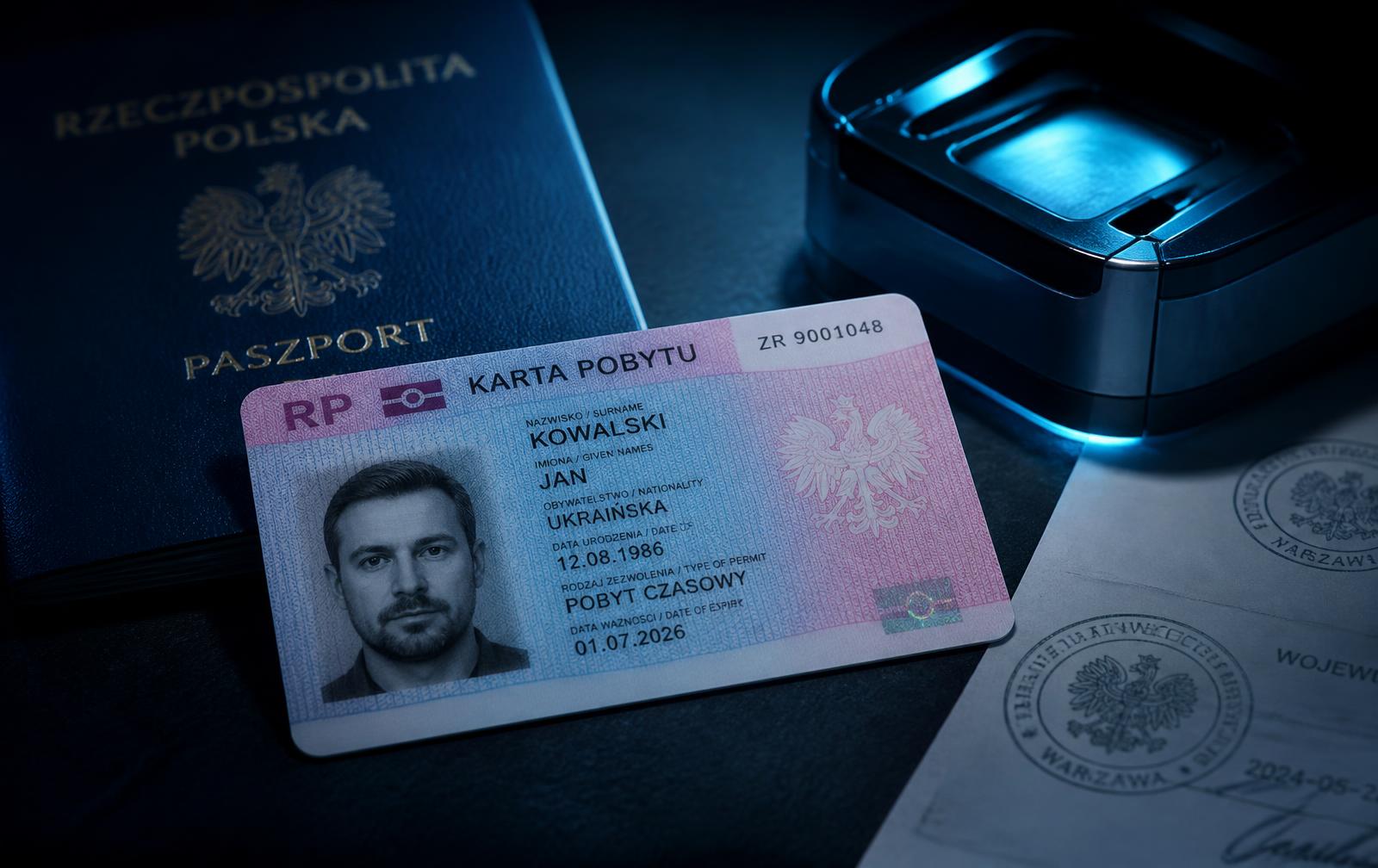
Residence cards
We run the full residence procedure for non-EU workers: choosing the right permit, compiling documents, filing the application with the voivode, the fingerprint appointment, the passport stamp and collection of the residence card. We track renewal deadlines so that stay and work are legal every single day.
- Single permit for temporary residence and work
- Annex no. 1 and full employer documentation
- Office appointment, fingerprints and passport stamp
- Calendar of renewals and card replacements
- Document
- Residence card
- Authority
- Voivode competent for the place of stay
- Validity
- Up to 3 years for temporary residence
- Applicant
- The foreign national, in person
- Pricing
- Flat rate per case
What a residence card is
A residence card is issued to a foreign national after a positive decision on a residence permit. It does not create the right of residence – it confirms it. Together with a valid passport it acts as an identity document and allows crossing Schengen borders without an additional visa.
Decision before document
First the voivode grants the residence permit, only then is the card produced. Without a decision there is no document.
Residence, not only work
The card legalises staying in Poland. The right to work comes from the annotation on the card or from a separate permit.
The deadline is decisive
The next permit must be applied for no later than the last day of legal stay. Being late closes the case.
Who this service is for
Companies employing workers on visas
Workers arrived on a national D visa and it is about to expire – a residence route is needed to let them stay longer.
Plants hiring in groups
A dozen or several dozen residence cases at once, one appointment schedule and one status report.
Employers with expiring cards
Residence cards expire in the coming months and you want to extend employment without a single day of illegal stay.
Companies before an audit or after an inspection
You need to organise residence documents and be sure every person stays and works on the correct legal basis.
Types of residence cards in Poland
The type of card follows from the decision behind it. For non-EU workers employed by a Polish company, the single permit for temporary residence and work is usually the right basis.
Temporary residence
The most common case. Issued after a temporary residence permit decision – for up to 3 years, with the option of further applications. For non-EU workers usually in the single-permit variant: residence and work in one decision.
Temporary residence and work (single permit)
One decision of the voivode covers the right of residence and the right to work for the indicated employer. The card carries an annotation on labour market access, so a separate type A permit is not required.
Permanent residence
For people meeting statutory conditions, including holders of the Pole's Card or spouses of Polish citizens. The right of residence is indefinite, while the card itself is issued for 10 years and is subject to replacement.
EU long-term resident
For foreign nationals with a sufficiently long, uninterrupted legal stay in Poland, stable income and health insurance. The card is issued for 5 years and carries broader rights in other EU states.
EU Blue Card
For highly qualified specialists with higher education or documented experience and a salary above the statutory threshold.
Single permit for temporary residence and work
This is the most common basis for workers from Asia employed long term in a Polish plant. One decision covers the right of residence and the right to work for the indicated employer.
One decision instead of two
The voivode rules on residence and work at the same time. There is no need to run a parallel type A permit procedure for the same employer.
Tied to the terms of employment
The decision names the employer, position, working time and minimum salary. The contract must match it from day one.
Annotation on the card
The residence card shows information on labour market access – this is the proof of legal employment during an inspection.
Change of employer
Changing the company or key terms of employment requires notification and usually a new decision. We review every such case before work starts.
If the worker is still abroad, the route starts with a type A work permit and a national D visa, and the residence card is the next step after arrival.
What exactly we do
We take over the entire formal layer – from choosing the right residence basis to tracking the deadline for the next application.
Analysis of the residence basis
We review the worker's situation – visa, existing documents and time spent in Poland – and select the right type of residence permit.
Compiling documents
The application, annex no. 1 from the employer, worker documents, biometric photos, sworn translations and the power of attorney.
Arranging the office appointment
We book the slot, prepare the worker for filing the application and giving fingerprints, and make sure the passport stamp is issued.
Running the proceedings
We answer requests to supplement the file, monitor case status and deal with the voivodeship office on your behalf.
Card collection and rollout
We hand over the decision and the card, check that the contract matches the permit and brief your HR team on its duties.
Renewal calendar
We track the validity of cards, visas and permits and start the renewal several months in advance.
What the application requires
The exact scope depends on the residence basis and the worker's situation, but the core list repeats. We collect and verify everything before the office appointment.
On the employer's side
- Annex no. 1 – information on the terms of employment
- Company registration data (KRS or CEIDG, NIP, REGON)
- Job description, working time and gross salary
- Employment contract or civil-law contract with the worker
- Document confirming the basis for work (if applicable)
On the worker's side
- Completed temporary residence permit application
- Valid passport – original and copies of completed pages
- Four current biometric photographs
- Proof of health insurance
- Document confirming the place of residence in Poland
- Sworn translations of foreign-language documents
How obtaining a residence card works
The model is the same for one case and for fifty – only the scale of document handling and status reporting changes.
Audit of the worker's status
We check the validity of the visa or previous card, the residence history and the basis of employment, then choose the right route.
Agreement and power of attorney
We sign the service agreement and the power of attorney that lets us represent the parties before the voivodeship office.
Compiling documents
We collect company and worker documents, prepare annex no. 1, photographs and sworn translations.
Filing and fingerprints
The worker files the application in person, gives fingerprints and receives the stamp confirming legal stay.
Proceedings at the office
We monitor status, answer requests and supplement the file without involving your team.
Decision and card collection
After a positive decision the card goes into personalisation and the worker collects it in person at the office.
How long it takes and how long it lasts
The duration depends mainly on the workload of the specific voivodeship office and on the completeness of the application. We set realistic schedules based on current practice in the given region.
up to 3 yrs
Maximum period of a temporary residence permit
several mos.
Typical duration of proceedings, depending on the office
2–3 months
Recommended lead time for a renewal application
What matters is the filing date, not the decision date. An application filed on time protects the stay throughout the proceedings, even if they take over a year.
Passport stamp, work and travel
Between filing and card collection the worker operates on the voivode's stamp. This is the most common source of confusion, so we brief both the worker and your HR team at the start.
What the stamp confirms
That the application was filed on time and without formal defects, and that the stay remains legal until the final decision – even if the visa expires in the meantime.
Work during the proceedings
Under a single permit, work for the employer named in the application may continue on the existing basis. We confirm every situation in writing before work starts.
What the stamp does not give
It does not replace a visa or a residence card for travel. Leaving the Schengen area during the proceedings may make it impossible to return to Poland without an additional document.
Travel after the card is issued
The residence card together with a valid passport allows travel across the Schengen area for tourism within the day limit – without the right to work in another country.
What the cost consists of
We quote before we start and do not change the price during the proceedings. Below is the full list of items that may appear in the calculation.
Stamp duty on the application
Paid when the temporary residence application is filed; the amount depends on the type of permit. We verify current rates for each case.
Fee for issuing the card
Charged after a positive decision, before the document is released. A higher rate applies to replacements caused by the holder.
Sworn translations and photos
Cover foreign-language documents and biometric photographs. The cost depends on the number of billable pages.
Our fee for handling the case
Agreed upfront as a flat rate per worker. No extra charges for correspondence, requests, office visits or supplements.
Renewing the stay and replacing the card
The next permit is separate proceedings, but built on documentation already gathered. The deadline is decisive: the application must be filed no later than the last day of legal stay.
Start 2–3 months earlier
We notify your HR team of the approaching deadline and begin compiling documents before the card expires.
Reusing the case file
The next application is built on earlier documentation – we only update what has actually changed.
Replacing the card
A change of data, loss or damage requires an application for a subsequent card. We handle these cases as well.
Where residence card holders usually come from
We handle residence cases for candidates from Asian markets we recruit ourselves, as well as for workers sourced by the client.

Philippines
Production, logistics and processing – candidates used to shift work.

India
Technical staff, welders and machine operators with documented qualifications.

Nepal
Blue-collar workers with low turnover who fit well into teams.

Bangladesh
Light industry, warehousing and food processing.

Sri Lanka
NVQ certificates, construction and manufacturing.

Indonesia
Production, HoReCa and logistics – candidates with verified skills.
The full document path – from the national D visa to the residence card – is described in our residence and work legalisation service. If you also need to find candidates, see one-off recruitment.
Risks we remove upfront
Border Guard and Labour Inspectorate checks focus on a few recurring areas. We verify each of them before it becomes a problem.
Application filed late
Even one day of delay means an illegal stay and the need to leave Poland. We keep a deadline calendar and start each case in advance.
Formal defects at filing
An incomplete application gets no stamp and does not protect the stay. We verify completeness before the appointment, using a checklist for the given office.
Contract inconsistent with the decision
A different position, lower salary or different working time than in the permit means work on terms inconsistent with the decision. We provide a contract template matching it.
Travel during the proceedings
Leaving the Schengen area on the stamp alone can block the return. We review every planned trip before tickets are bought.
Photos from residence card cases
Applications, office visits and collecting residence documents for our workers.
Frequently asked questions about residence cards
What exactly is a residence card?
A residence card is the document a foreign national receives after a positive decision on a temporary residence, permanent residence or EU long-term resident permit. The card itself does not grant the right of residence – it confirms it. The right comes from the voivode's decision, and the card is its physical proof: an identity document that, together with a passport, allows travel across the Schengen area.
How is a residence card different from a work permit?
A type A work permit legalises work for a specific employer. A residence card follows from a residence permit and legalises the stay itself. These are two separate tracks that usually run in parallel. The exception is the single permit for temporary residence and work, where one decision of the voivode covers both at once.
What is the single permit for temporary residence and work?
It is the most common route for non-EU workers employed by a Polish company. In one decision the voivode rules on both the right of residence and the right to work for the indicated employer, in the indicated position and at the indicated salary. After the decision the worker receives a residence card with an annotation on labour market access.
Who files the application – the worker or the employer?
The application for a temporary residence permit is filed in person by the foreign national, because fingerprints are taken at the office. The employer, however, provides a key part of the documentation: annex no. 1 with the terms of employment, company registration data and details of the position. We compile both sides of the file, book the appointment and prepare the worker for the visit.
How long does it take to obtain a residence card?
In practice from several months to over a year – it depends on the workload of the specific voivodeship office. Producing the card itself after a positive decision usually takes a few weeks. Throughout the proceedings the stay remains legal, provided the application was filed on time and the voivode placed a stamp in the passport.
What is the passport stamp and does it allow work?
The voivode's stamp confirms that the application was filed on time and without formal defects, and that the stay in Poland remains legal until the decision is issued. It allows work for the employer named in the application, but it does not permit free travel across the Schengen area or re-entry to Poland after leaving without a valid visa.
How long is a temporary residence card valid?
A temporary residence permit is granted for a maximum of 3 years, and the card is valid for the period stated in the decision. A permanent residence card is issued for 10 years, although the right of residence itself is indefinite – only the document is replaced.
When should the renewal application be filed?
At the latest on the last day of legal stay, but in practice we recommend starting 2–3 months earlier. An application filed late means an illegal stay and the need to leave Poland. We keep a calendar of card, visa and permit expiry dates and give advance notice.
What if the worker changes employer during the proceedings?
Changing the employer or the terms of employment during proceedings for a single permit requires an update to the application and usually a new annex no. 1 from the new employer. After the card is issued, a change of employer must be reported and most often requires a new decision. We analyse every such case before the worker starts.
How much does a residence card cost?
The cost consists of the stamp duty on the temporary residence application, the fee for issuing the card itself, any stamp duty on the power of attorney and the cost of sworn translations. We verify official rates for each case, and our own fee is agreed upfront as a flat rate per worker.
What if the residence card is lost or damaged?
The loss or damage must be reported without delay to the voivode who issued the document, together with an application for a subsequent card. A higher fee applies when the replacement is due to the holder's fault. We handle such cases alongside the rest of the worker's documentation.
Do you handle workers we did not recruit through you?
Yes. We can handle residence legalisation only, for people already employed by your company or sourced by you. In that case we are responsible for the documentation, deadlines and contact with the office, and you for the terms of employment.
We will review your workers' deadlines.
We reply within 48 hours with an assessment, a document list, costs and a schedule – no commitments and no upfront fees.