
Loyalty and commitment
Filipino workers are known for perseverance and loyalty to their employer – this translates into low turnover and a stable team.


 Recruitment from the Philippines
English-speaking, verified workers from the Philippines for Polish manufacturing, construction and logistics companies. We manage the entire process: candidate selection, work permits, DMW accreditation, visas, relocation and onboarding at your site – usually within 3–5 months.
Philippines · Southeast Asia
The Philippines has for decades been one of the world's largest exporters of labour – millions of Filipinos work legally in the UAE, Japan, Canada and Western Europe. For Polish employers, this means access to candidates who understand the realities of an overseas contract, hold documented qualifications and speak English – the official and teaching language of the Philippines.
Recruitment from the Philippines is a regulated process on both sides: in Poland a work permit and a national visa are required, while in the Philippines an employer accreditation and contract approval by the DMW are needed. We manage the entire process from start to finish, so the company gets a single timeline, a single budget and a single coordinator.
3–5
months from contract to arrival
100%
legal employment and residence
5500+
workers recruited
20+
languages in customer service
Other directions
We also recruit from India, Nepal, Bangladesh, .
See all directionsBenefits
Filipino workers are known for perseverance and loyalty to their employer – this translates into low turnover and a stable team.
The Philippines is one of the largest English-speaking countries in Asia. Communication on the shop floor and in the office works from day one.
Many candidates hold higher or technical education and experience in construction, manufacturing and logistics.
A culture of cooperation and respect for supervisors makes it easier to integrate into Polish organisational structures.
They adapt quickly to change, shift systems and new procedures – shortening onboarding time.
If a worker does not meet expectations during the probationary period, we provide a free replacement.
We run the process in five stages: contract and accreditation application, recruitment, the Philippine procedure (DMW), the Polish work permit, and relocation. Each stage has a clear timeline and a full set of documents – below we show step by step what happens, how long it takes and who covers the costs.
3–5 mo.
from contract to first day of work
5 stages
one coordinator manages the whole process
100%
compliance with DMW and voivodeship office requirements
Process stages
The process begins with signing the contract with Primework and preparing the employer accreditation application – 500 EUR per application, regardless of headcount (max. 20 per job order).
Contract and accreditation application
After signing the contractAccreditation starts once the contract with Primework is signed. We charge 500 EUR for each employer accreditation application prepared – regardless of the number of people in the job order (max. 20 per order).
Additional job order – no extra fee
Order expansionIf you need more than 20 people or add further positions, we file what is called an additional job order under the existing accreditation. It is free of charge with us.
We start from the job profile, not the CV. Initial candidate pre-screening and – on request – video calls or in-person interviews, before formalities even begin.
Job profile and contract
Week 1–2Scope of duties, required certificates, pay, shift pattern and accommodation. The contract is drafted from the outset in a form acceptable to the DMW.
Pre-screening in the Philippines
Week 2–4Local partners verify CVs, references and TESDA certificates, and check the history of previous overseas contracts.
Pre-selection and candidate choice
Week 3–5We present a shortlist of profiles with recordings. The final choice belongs to the company. Video calls and in-person interviews are arranged on request; practical tests are a separately charged service.
Accreditation at the Philippine Embassy in Prague, contract approval by the DMW, medical checks, PDOS, OEC and the national visa at the Polish consulate.
Accreditation at the Philippine Embassy in Prague
Week 9–12Registration documents, certifications and verification of employment conditions. The Embassy in Prague handles accreditation applications for Polish employers.
Contract approval by the DMW
Week 11–15The contract must meet Philippine standards – including a ban on charging recruitment fees to the worker.
Medical checks, PDOS and OEC
Week 13–17Medical examinations at an accredited clinic, the PDOS pre-departure orientation seminar and the OEC certificate authorising departure.
National visa D
Week 14–18Booking an appointment, an interview at the Polish consulate in Manila and collecting the visa with the work permit entered.
Documentation, labour market test and application at the voivodeship office – run in parallel with the Philippine track.
Compiling documentation
Week 3–4Company data, job description, employment terms and declarations. We check compliance with office requirements before filing.
Labour market test
Week 4–7If required for the position – submitting the vacancy to the district labour office and obtaining the starost's opinion.
Decision: Type A permit
Week 4–12Application at the voivodeship office. The typical decision time is 30–60 days, depending on the voivodeship.
Tickets, transfer, accommodation, PESEL number, bank account and onboarding at the workplace – with a coordinator on both sides.
Tickets and transfer
Week 16–20Booking the flight from Manila, airport transfer and pickup of the group by an English-speaking coordinator.
Accommodation and registration
First weekAccommodation meeting sanitary requirements, address registration, PESEL number application and opening a bank account.
Health and safety induction
First weekHealth and safety training and job instructions in English, assignment of a team supervisor and the first day of work.
Support and 90-day review
Month 1–3Basic Polish language course, support with residence matters and a review of the cooperation with the employer after three months.
Typical timeline
From contract to the first day of work – usually 3–5 months
Job profile and offer
01Candidate selection
02Type A work permit
03DMW, medical checks and visa D
04Arrival and first day of work
05Cost of employment
Official fees
EmployerType A work permit application, visa fee, sworn translations and document legalisation.
Accreditation application – 500 EUR
EmployerFixed fee for each employer accreditation application prepared, regardless of headcount (max. 20 per job order). We prepare additional job orders free of charge.
Philippine procedure
Employer / agencyContract approval by the DMW, medical examinations, PDOS training and OEC.
Flight and relocation
EmployerFlight ticket from Manila, airport transfer, initial accommodation and starter kit.
Agency fee
EmployerRecruitment, process management, official handling and post-arrival coordinator support.
Practical tests (optional)
EmployerSkills tests organised on site in Manila at the employer's request – a separately charged service.
We do not quote a single price per worker – the budget depends on the position, headcount and voivodeship. However, it always consists of the same line items, making it possible to compare agency offers without hidden costs. We handle the formalities on the employer's behalf, but every stage is documented and reported.
Ready to start
Recruitment partner in the Philippines
Recruitment in the Philippines is carried out by the licensed agency Praxis International Staffing and Management – our partner responsible for sourcing and pre-screening candidates and handling the DMW procedure.
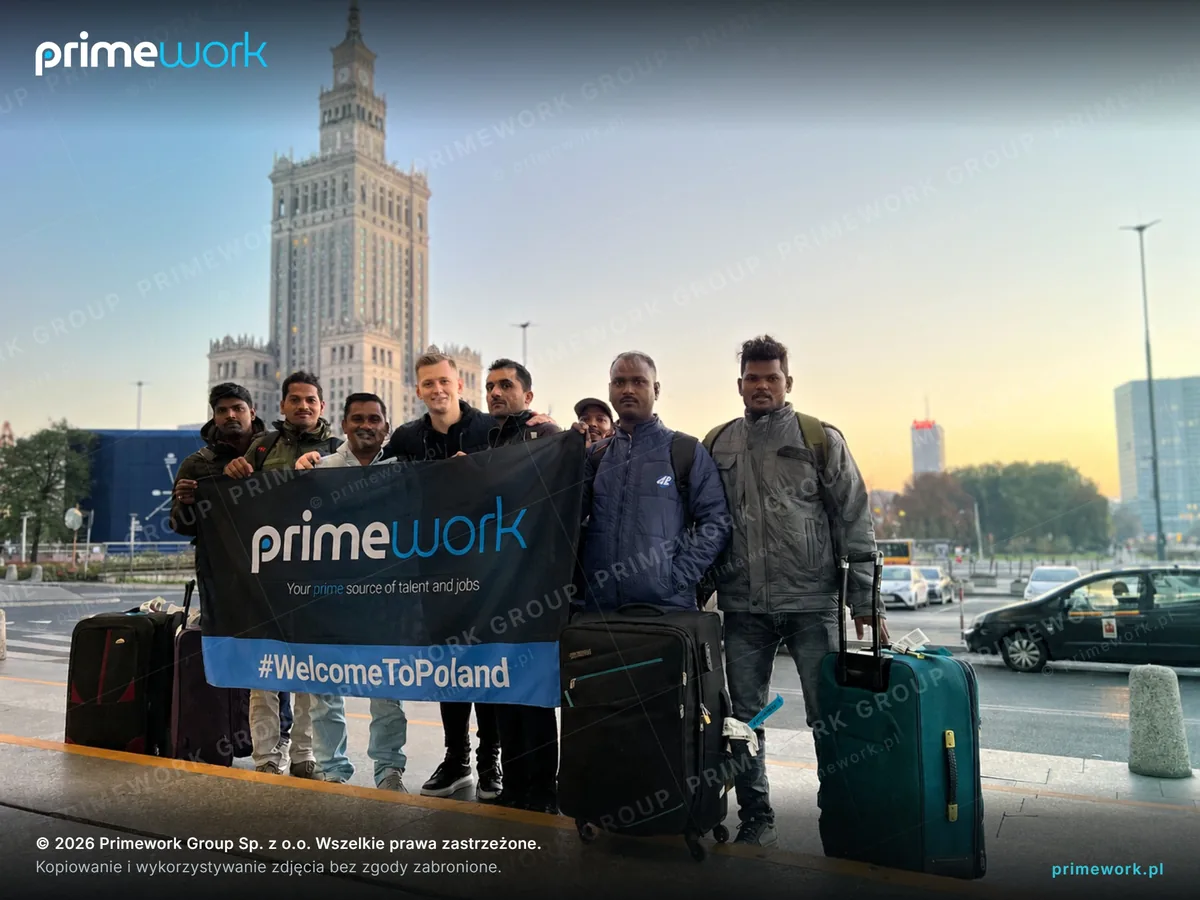
praxisintl.com.phSelected photos from our work: arrivals, onboarding and day-to-day support for groups from the Philippines.
Where Filipino workers excel
Positions
These are most often roles requiring consistent quality, shift work and verified qualifications. TESDA certificates make it possible to verify skills even before the interview with the employer. Practical tests are a separately charged service – we organise them on site in Manila at the company's request.
Need a different profile? We also recruit from other countries in Asia, Africa and South America.
A comparison of typical differences in the process and candidate profile.
| Criterion | Philippines | Other countries |
|---|---|---|
| English proficiency | Very good – official language | Usually basic |
| Process duration | 3–5 months | 1–4 months (visa-free routes) |
| Turnover after 12 months | Low – long-term contracts | Higher, frequent employer changes |
| Professional certification | TESDA – a recognised qualification system | Varying levels of documentation |
| Formalities | Permit + DMW + visa D | Permit or declaration |
Cultural integration
Filipino workers value close relationships, respect for authority and cooperation. A few simple measures make onboarding faster and help the team work cohesively.
Language barrier
Basic Polish language courses, health and safety materials and job instructions in English, and pictograms on the shop floor.
Cultural differences
Training for Polish supervisors (indirect communication, the importance of hierarchy) and orientation sessions for workers before departure.
Feeling of isolation
Group recruitment, an English-speaking team supervisor, support in staying in touch with family, and space to celebrate Filipino holidays.
Turnover and competition for people
A clear path for extending stay and promotion, a predictable schedule and a review of conditions after 6 and 12 months.
Quick answers to common questions about recruiting workers from the Philippines.

Give us a call – we will advise you on the best solution for your company.
Call usThe Philippines is one of the world's largest English-speaking labour markets and a country with a long tradition of overseas employment. Candidates are used to international standards, hold documented qualifications (TESDA certificates) and show low turnover – for an employer this means a shorter onboarding period and a stable team.
1) Needs analysis and job description, 2) initial pre-screening of candidates in the Philippines – verification of CVs, references and TESDA certificates (video calls with the employer and in-person interviews are available at the company's explicit request), 3) Type A work permit at the voivodeship office, 4) employer accreditation and contract approval by the DMW (formerly POEA) and the Philippine Embassy, 5) national visa D at the Polish consulate, 6) arrival, accommodation, registration and onboarding.
Realistically 3–5 months from signing the contract to the first day of work. The longest stages are the work permit (usually 30–60 days) and the DMW procedure plus visa (roughly 6–10 weeks combined). Timelines depend on the workload of the voivodeship office and the consulate.
We launch accreditation once the contract is signed. We charge 500 EUR for each employer accreditation application prepared – regardless of whether it covers 1, 5 or 20 people (20 is the maximum per job order). If you need more workers or additional positions, we file what is called an additional job order, which is free of charge with us. Accreditation applications are handled by the Philippine Embassy in Prague.
Recruitment is carried out by the licensed agency Praxis International Staffing and Management – our partner in the Philippines. They are responsible for sourcing and pre-screening candidates, verifying TESDA certificates and handling the DMW procedure.
A Type A work permit (or a single permit), a labour market test – if the position is not exempt, an employment contract compliant with the permit conditions, employer accreditation at the Philippine Embassy and contract approval by the DMW, and after arrival registration with ZUS (social insurance) and notification to the relevant office of employment commencement. We compile and submit these documents on your behalf.
The cost consists of official fees (work permit, visa), the costs of the Philippine procedure and medical checks, the flight ticket and the agency's fee. Philippine law prohibits charging recruitment fees to the worker, so the process costs are borne by the employer. We present the exact budget in the offer before the process starts – with no hidden fees.
Our initial pre-screening is standard – we verify CVs, TESDA certificates and references, leaving the final candidate selection to the employer. Video interviews and in-person meetings are organised at the company's explicit request. Practical tests are a separately charged service – we organise them on site in Manila if the employer wishes.
Yes. English is an official and teaching language in the Philippines, so the vast majority of candidates communicate fluently. Health and safety instructions and on-the-job training can be delivered in English from day one, and we teach basic Polish during onboarding.
Production and the food industry, logistics and warehousing, construction and finishing works, welding and metalworking, hospitality and catering, and care work. These are sectors where availability, shift work and consistent quality matter most.
Yes. Employment conditions – pay, working hours, position – must be no worse than for Polish workers in a comparable role. This is a condition for issuing a work permit and is checked by the National Labour Inspectorate (PIP) and the Border Guard.
It is standard for accommodation to be provided by the employer or the agency. We arrange tickets, airport transfer, accommodation meeting sanitary requirements, registration and the first formalities (PESEL number, bank account).
During the agreed probationary period we provide a free replacement of the worker. Throughout the contract, one coordinator supports both the company and the worker, addressing issues before they lead to turnover.
Destination: the PhilippinesWe start with a conversation about your needs and a quote. Only after the contract is signed do we launch accreditation, the job order and recruitment in the Philippines – with an agreed arrival schedule. No promises of "candidates on demand".
Realistic time from contract to the first day at work: 3–5 months.