A direction for companies looking for technical staff with documented qualifications and very low turnover. Colombia's SENA system, Argentine industrial experience and genuine shift readiness – bundled with full legalisation and relocation.
3 countries: Colombia, Guatemala, Argentina
SENA diplomas and verifiable technical qualifications
Very low turnover – stays planned in years
Type A permit, D visa, apostille, flight and housing handled by us
Why South America is the direction for stable staffing
It is the least obvious direction in our portfolio and at the same time the one with the lowest turnover. The distance that looks like a drawback is in fact the main factor stabilising the team.
A candidate from Bogota or Buenos Aires does not come for a single season. The cost and length of the journey mean the decision is made for several years and usually discussed with the whole family. For an employer that means staffing which does not disappear after the first winter.
Colombia adds something most directions lack: SENA, a state vocational system with examinations and a verifiable diploma. It trains welders, mechanics, electricians, machine operators and food processing staff – precisely the profiles Polish industry is short of.
Argentina brings experience from automotive and food plants running to European quality standards, while Guatemala works well in agriculture, orchards and processing, where stamina and teamwork matter most.
The challenges are language and logistics. Spanish is the baseline, so instructions are prepared bilingually and larger groups get a Spanish-speaking coordinator. Add apostilles and a long flight, and the timeline lands at 14–20 weeks.
3
Latin American countries in continuous coverage
14–20 wks
from signing to the first batch on site
SENA
Colombia's state qualification system with examinations
24–36 mo
typical stay and employment horizon per candidate
02Countries
Countries we recruit from in South America
Colombia handles the largest volume, Guatemala the agricultural and processing directions, Argentina technical staff.
Latin teams run on relationships. A well-led crew can be the closest-knit group in the plant – but it needs a different management style than a Polish team.
Relationship before procedure
Loyalty is built towards a specific supervisor rather than the company as an institution. A worker who feels respected stays for years.
For the employer: Invest the team leader's time in the first two weeks – it returns in annual retention.
Teamwork and atmosphere
The group works and solves problems together. Singling out one person at the expense of the rest can break a well-functioning crew.
For the employer: Reward team results alongside individual ones – that matches how this group naturally works.
Spanish as the operational language
English cannot be assumed. Instructions, safety training and shop-floor notices should have a Spanish version.
For the employer: Bilingual instructions with drawings plus a Spanish-speaking coordinator solve 90% of the issue.
Rhythm of work and predictability
Shift work and overtime are not a problem, but last-minute plan changes reduce engagement and sour the mood in the group.
For the employer: Stick to the published roster and settle hours transparently on the payslip.
A Latin crew led by a good team leader is the closest-knit group in the plant. The same crew poorly led falls apart within a month.
Primework coordination team
04Skills
Qualifications – how we verify South American candidates
A candidate profile includes apostilled and translated diplomas, employment history and a language rating. An optional practical test recording for technical roles is available only as a paid add-on on client request.
SENA diplomas and technical qualifications
Colombia's SENA ends with a state examination and a verifiable diploma. Argentina and Guatemala have equivalents in technical schools and industry certificates.
Apostille and sworn translations
All three countries are parties to the Hague Convention, so documents receive an apostille and a sworn translation into Polish before the visa appointment.
Practical test and work video
Welders produce weld samples, operators demonstrate machine work, mechanics document repair scope. The material reaches the profile before the interview.
Licences completed in Poland
EN ISO 9606-1 exams, UDT licences for forklifts and cranes and a basic Polish course are arranged after the group arrives.
Sectors we staff with South American candidates
Manufacturing Food processing Welding and mechanics Warehousing Construction Transport Hospitality and hotels
05Process
How recruitment from South America runs
The biggest variables are the apostille and the visa appointment, so both start in parallel with the permit procedure.
1
Consultation and role profile
Day 1–3
We agree duties, required licences, shift system, pay and housing standard.
2
Contract and recruitment campaign
Week 1
We launch sourcing with partners in Bogota, Guatemala City and Buenos Aires.
3
Selection and video interviews
Week 2–4
A shortlist with SENA diplomas and language rating. A practical test is available only as an optional paid add-on on client request. Interviews run with Spanish interpreting.
4
Type A work permit
Week 4–12
Application at the voivodeship office for the whole group at once.
5
Apostille, translations and D visa
Week 8–18
Document legalisation in the home country and an appointment at the Polish consulate.
6
Flight, pickup and accommodation
Week 16–20
Tickets, airport pickup, transfer to housing, starter pack, address registration, PESEL and a bank account.
7
Onboarding and coordinator support
First 3 months
Medicals, safety training, bilingual instructions, a Spanish-speaking coordinator and reviews at 30 and 90 days.
06Formalities
Legalising employment of workers from South America
The route mirrors Asian directions with one difference: an apostille instead of consular legalisation, which usually shortens the document stage.
01
Type A work permit
Employer application at the voivodeship office, tied to a specific role and salary.
02
National D visa
Issued by the Polish consulate in Bogota, Guatemala City or Buenos Aires on the basis of the work permit.
03
Apostille and sworn translations
Diplomas, work certificates and civil status records receive an apostille and a sworn translation from Spanish into Polish.
04
Long-term residence
After arrival we file for the single permit for residence and work and track address registration, PESEL and renewal deadlines.
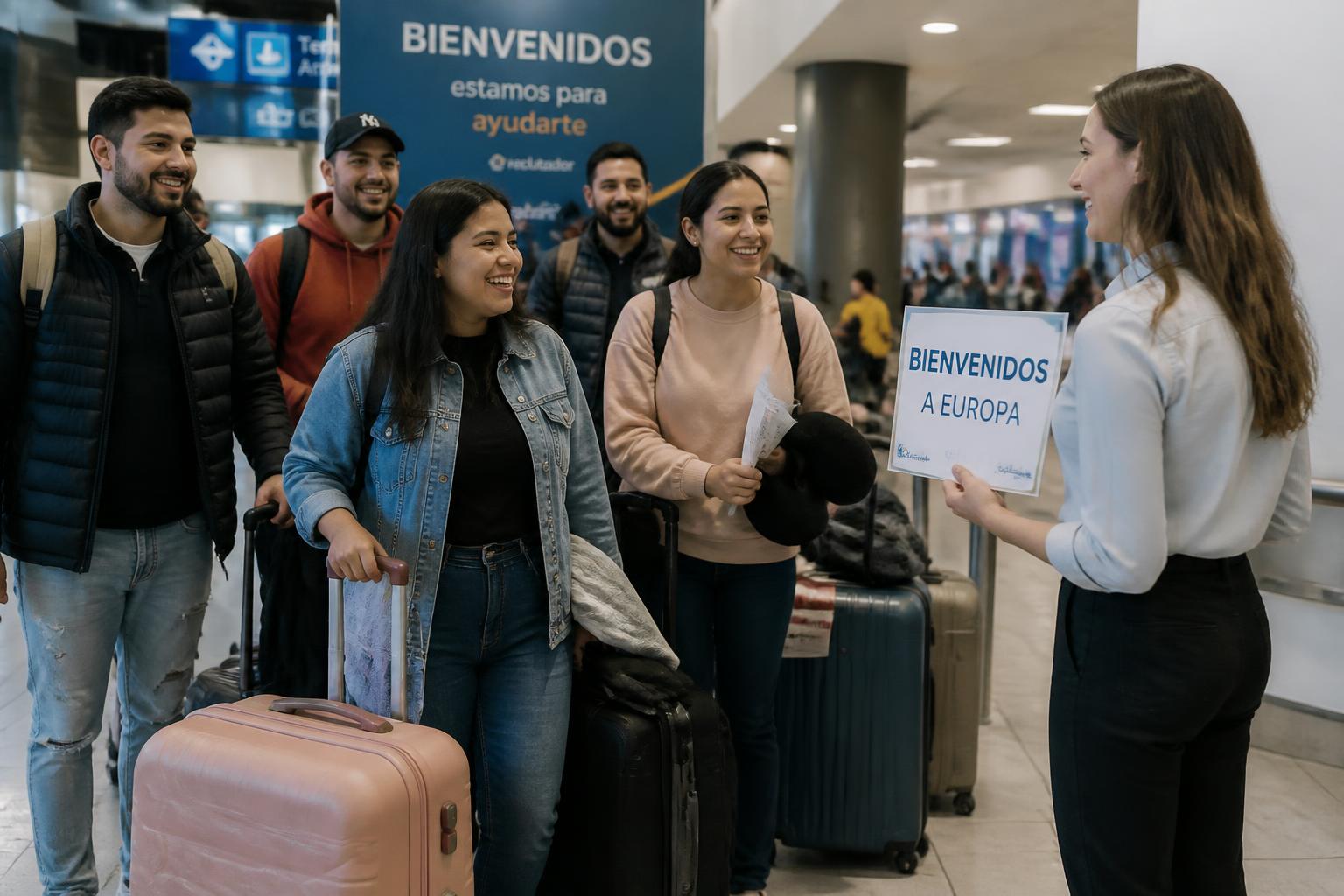
After a long flight the group is met by a Spanish-speaking coordinator. Below are frames from arrivals, interviews and first days in Poland.
Arrival photos
Group pickup at the airport
Colombia – batch of 16
Coordination and legalisation team
Warsaw, ul. Fabryczna 18
Video interviews with candidates
Selection with the employer
08Practice
Best practices for the first 90 days
On this direction everything starts with the team leader and the language. Get those two right and the rest follows.
What works
Bilingual workstation and safety instructions with a Spanish version
A Spanish-speaking coordinator or team leader for groups above 10 people
Team bonuses alongside individual ones – the group's natural way of working
A kitchen in the accommodation and housing people from the same country together
A basic Polish course funded by the employer
A review at 30 and 90 days with the coordinator present
What to avoid
Criticising a worker in front of the whole crew – it costs the most here
Assuming the candidate will manage in English
Splitting a close-knit group across different houses and shifts
Changing terms after a long and expensive flight
Skipping the apostille before the visa appointment – the main cause of delays
Treating the direction as seasonal when its advantage is multi-year stability
09FAQ
Frequently asked questions about workers from South America
Colombia, Guatemala and Argentina. Colombia is the main direction thanks to the SENA vocational system and candidate availability, Guatemala works well in agriculture and food processing, and Argentina provides technical staff with automotive and food industry experience.
Usually 14–20 weeks. Selection is fast, but apostilles, sworn translations from Spanish and the visa appointment in Bogota, Guatemala City or Buenos Aires add time. Flights are long, so batches are planned with a buffer.
The primary language is Spanish. English can be conversational among candidates from larger cities and those with technical education, but we never assume it. For larger groups we assign a Spanish-speaking coordinator and prepare bilingual instructions.
Colombia's SENA is an extensive state vocational system with examinations – it trains welders, mechanics, electricians, machine operators and food processing staff. A SENA diploma is verifiable. For technical roles we can arrange an optional practical test as a paid add-on on client request.
A very good team atmosphere, high loyalty to a supervisor who treats people as partners, and great importance placed on personal relationships. Criticism in front of the group lands badly, while praise can shift the mood of an entire crew.
Yes. Candidates are used to shift systems and overtime, especially in food processing and manufacturing. The condition is a predictable roster and clear rules on how hours are settled.
Yes. Colombia, Guatemala and Argentina are parties to the Hague Convention, so diplomas and civil status records receive an apostille and are then translated by a sworn translator. We run this before the visa appointment.
The largest item is the flight – higher than from Asia or Africa. On top come the type A permit, apostille and translations, visa fees, transport, accommodation, medicals and safety training plus the agency fee.
Low. Distance and the cost of returning mean candidates arrive with a multi-year plan, and attachment to the team and supervisor stabilises staffing further.
The key ones are housing people from the same country together and providing kitchen access. Latin cuisine is an important part of daily life and cooking together genuinely eases adaptation in the first weeks.
Our coordinator. Pickup, transfer to housing, a starter pack, address registration, PESEL, bank account and medicals are part of the standard relocation package.
Yes. We operate under a KRAZ certificate, maintain a full document register for every worker and track renewal deadlines for permits and residence cards.